Rise and Fall of European Dictators: A Study of Totalitarian Regimes
This article examines the political philosophies and actions of key dictators in Europe and Japan during the 20th century, including Joseph Stalin in the Soviet Union, Benito Mussolini in Italy, Adolf Hitler in Germany, and Emperor Hirohito with Prime Minister Tojo in Japan. It explores their totalitarian governments, ideologies of nationalism, fascism, and militarism, and the impacts of their policies, such as industrialization, military expansion, and human rights violations. Individual actions, historical context, and the legacy of these leaders are analyzed.


Rise and Fall of European Dictators: A Study of Totalitarian Regimes
E N D
Presentation Transcript
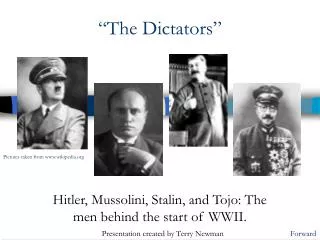
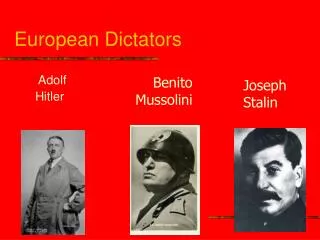
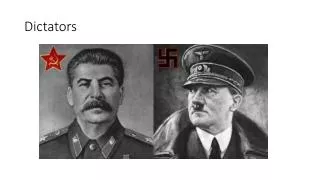
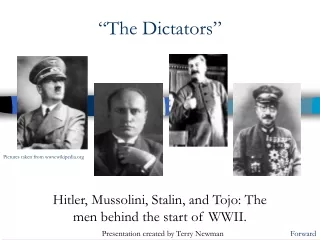
Political Leaders • Soviet Union – Joseph Stalin • Italy – Benito Mussolini • Germany – Adolf Hitler • Japan • Emperor Hirohito • Prime Minister Tojo
Soviet Union Politics Model Communist State • No social class system • Revolution by workers • State ownership of property • Become an industrial power • Self-sufficient • Totalitarian state
Italian Political Beliefs Fascism • Strong central government • Dictator • Nationalism • Expansion • Anti-communist
German Political Beliefs Nazi Party • Extreme nationalism • Extreme racism – Aryan Race • National expansion • Military growth • Strong government controls • Dictator
Japanese Politics • Nationalistic • Strong military • Military expansion
Actions of Stalin • Five Year Plan to industrialize • Collective farms • Police state • Citizens have limited rights • Labor camps • Purges
Actions of Mussolini • Organized the Black Hand • Marched against King to gain power • Created a totalitarian state • Built military • Invaded Ethiopia
Actions of Hitler • Promoted a pure race • Dismantled the Weimar Republic • Established the 3rd Reich • Quite the League of Nations • Built up a military • Refused to pay WWI reparations
Actions of Japanese • Limited rights of citizens • Quite the League of Nations • Invaded China