Prisms and Polyhedrons
Explore the fascinating world of prisms and polyhedrons, closed spatial figures composed of polygonal faces. Discover the essential elements, including edges, vertices, and face types. Learn about the different types of prisms, such as triangular, rectangular, and hexagonal prisms, and how they are named based on their base shape. We also cover right and oblique prisms, highlighting their unique characteristics. Lastly, understand the dimensions of a right rectangular prism and the formula for calculating its diagonal.


Prisms and Polyhedrons
E N D
Presentation Transcript
A closed spatial figure composed of polygons, called the faces of the polyhedron. The intersections of the faces are the edges of the polyhedron. The vertices of the faces are the vertices of the polyhedron. What is a polyhedron?
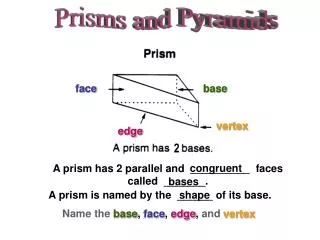
A polyhedron that consists of a polygonal region and its translated image of a parallel plane, with quadrilateral faces connecting corresponding edges. Prism
A right prism is a prism in which all of the lateral faces are rectangles. An oblique prism has at least one nonrectangular lateral face Types of prisms
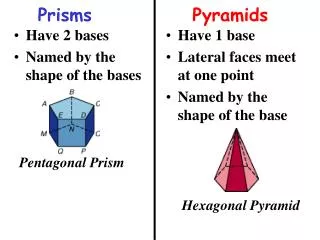
A prism is named by the shape of its base • Types • Triangular prism • Rectangular prism • Pentagonal prism • Hexagonal prism How do we name prism?
The faces formed by the polygonal regions and its image are each called a base of the prism. The remaining faces, which are quadrilaterals, are called the lateral faces of the prism. The edges of the lateral faces that are not edges with either base are called the lateral edges. Parts of prisms
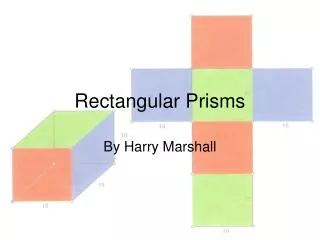
In a right rectangular prism with the dimensions l x w x h, the length of the diagonal is given by: Diagonal of right rectangular prism