Graphing Quadratic Functions and Finding Vertex
Learn how to graph quadratic functions, identify their vertex and axis of symmetry, and find maximum or minimum values. Practice problems included.

Graphing Quadratic Functions and Finding Vertex
E N D
Presentation Transcript
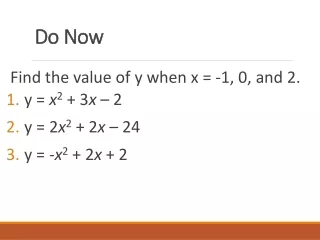
Do Now • Find the value of y when x = -1, 0, and 2. • y = x2 + 3x – 2 • y = 2x2 + 2x – 24 • y = -x2 + 2x + 2
2.2: Characteristics of Quadratic Functions Objective: graph quadratic functions and identify their vertex and axis of symmetry
Axis of symmetry • The axis of symmetry is a line that divides a parabola into mirror images and passes through the vertex. • Cuts a parabola in half
Example 1: • Plot the vertex at (- 3, 4). • The axis of symmetry will be at the line vertically along the x value of the vertex. • x = -3 • Plot two more points on the graph • (- 2, 2) and (- 1, - 4) • Draw the parabola through the points.
Practice • Graph y = 3(x - 2)2+ 1. Label the vertex and axis of symmetry.
Quadratic Equation • Standard Form: f(x) = ax2 + bx + c • Equation for the line of symmetry: • x-coordinate of vertex (find y-value by plugging in x-value and solving):
Steps to graphing a quadratic equation in standard form: Standard form: f(x) = ax2 + bx + c 1.) Find x-coordinate of the vertex: 2.) Create table with x-coordinate of vertex in the middle and choose at least one value smaller than vertex and one value larger than vertex for x. 3.) Plug in values for x and solve for y. 4.) Plot points and draw parabola.
Graphing using intercept form f(x) = a(x – p)(x – q) • Plot the x-intercepts: points p and q • Find x-coordinate of vertex by averagingp and q: • Find y-coordinate of vertex by plugging in x-coordinate and solving. Plot the vertex.
Homework: Textbook pg. 61-63 # 9, 29, 41, 56