Understanding Earth’s Surface Shaping: Weathering and Erosion Processes
Explore how weathering and erosion shape Earth’s surface. Weathering involves the systematic breakdown of the Earth's crust through mechanical and chemical processes, influenced by agents like wind, water, ice, and air. Erosion transports sediments, significantly altering landscapes. Factors like the volume and velocity of water play crucial roles in erosion's effectiveness. In addition, glaciers, wind, and unique features like moraines, eskers, and oxbow lakes illustrate the dynamic interactions shaping our planet's diverse terrains.

Understanding Earth’s Surface Shaping: Weathering and Erosion Processes
E N D
Presentation Transcript
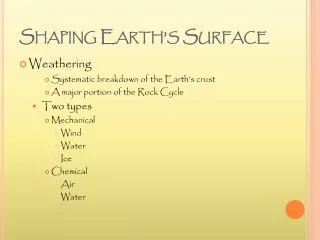
Shaping Earth’s Surface • Weathering • Systematic breakdown of the Earth’s crust • A major portion of the Rock Cycle • Two types • Mechanical • Wind • Water • Ice • Chemical • Air • Water
Shaping Earth’s Surface • Erosion • Systematic transportation of sediments as a result of weathering • Erosive agents • Wind • Water • Most effective • Volume of water • Velocity of flow • Ice • Work of Rivers • Meanders • Flood plain • Oxbow lakes • Deltas
Shaping Earth’s Surface • Glaciers • Massive collection of ice & snow • Located in the higher altitudes • Types • Continental • Moraines • Eskers • Erratics • Alpine • Hanging valleys • Cirques • Horns
Shaping Earth’s Surface • Wind • Loess