Significant Figures
Significant figures are crucial for conveying the precision and accuracy of measured values. The rules for identifying significant figures include recognizing all non-zero numbers as significant, counting zeros between significant digits, and knowing which zeros do not count when in front of a decimal point. Moreover, when performing calculations, the final result must reflect the correct number of significant figures based on the least precise value in the operation. Mastering these rules ensures clarity and consistency in scientific communication, vital for accurate data analysis.


Significant Figures
E N D
Presentation Transcript
Significant Figures SIG FIGS!!!!!!!
Importance of Sig figs • Sig figs tell people the precision of a value. • Precision: how many times you can achieve the same result. (dart and #19 over and over) • Accuracy: how close your value is to the true value (dart and bulls-eye)
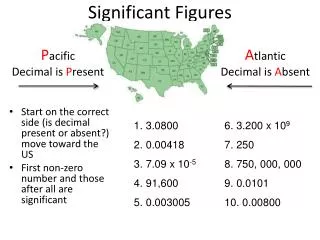
Rule #1 • All real numbers are sig figs. • Ex. 1235 (4) • Ex. 4487558 (7) • Ex. .2257 (4) • Ex. 14.88597 (7)
Rule #2 • All zeros between real numbers are sig figs. • Ex. 2007 (4) • Ex. 24.0559 (6) • Ex. 800000000000000004.05 (20)
Rule #3 • All zeros behind a real number in FRONT of a decimal are not sig figs. • Ex. 5000 (1) • Ex. 410 (2) • Ex. 100000 (1)
Rule #4 • All zeros BEHIND the decimal and in FRONT of a real number are not sig figs. • Ex. 0.0045 (2) • Ex. 0.0000078 (2)
Rule #5 • All zeros BEHIND the decimal and BEHIND a real number are sig figs. • Ex. 0.22570 (5) • Ex. 0.998700 (6) • Ex. 45.10 (4) • Ex. 0.004580 (tricky…the underlined zeros do not follow this rule.. 4)
How many sig figs? #1 50069 (?) • 5sf #2 50069.004 (?) • 8sf #3 448.000 (?) • 6sf #4 8000 (1) • 1sf
Addition and subtraction • When adding and subtracting—pay attention to the number of digits behind the decimal point. • Lowest number wins! • Ex. 12.005 3 digits behind + 1.01 2 digits behind 13.015 = 13.02 2 digits behind
Multiplication and division • When multiplying and dividing, pay attention to the total number of sig figs in each value in the problem. • Lowest number wins! • Ex. 12.501 5 sig figs x 0.23 2 sig figs 2.87523 = 2.9 only 2 sig figs