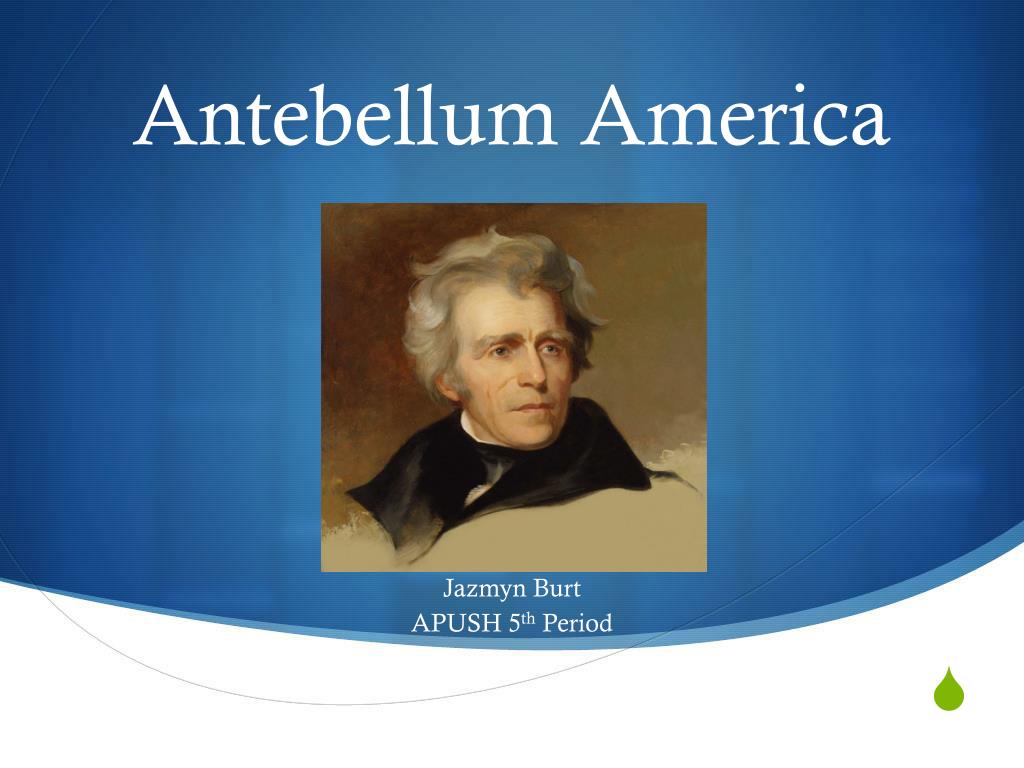
Antebellum America Jazmyn Burt APUSH 5th Period
Andrew Jackson • In 1812 the United States declared war on Great Britain and young Andrew Jackson was appointed commander of the Tennessee militia. • Jackson was then commanded to break the ally between the Creek Indians and the British. • In March 1814, with the help of the Cherokee Indians, Jackson defeated the Creeks at Horse Bend. • This victory gave Jackson a reputation and enabled him to become the Commander for the upcoming Battle of New Orleans. • On January 8, 1815 Andrew Jackson won the Battle of New Orleans, making him a national war hero.
Andrew Jackson • After gaining popularity from the people for being a national hero, Andrew Jackson decided to run for president. • After James Monroe served in office, Andrew Jackson, John Adams, William Crawford and Henry Clay ran for election in 1824. • Henry Clay and William Crawford lost in favor of Andrew Jackson, and John Adams. • Jackson won both the popular and electoral vote, but it was not enough to win presidency. Therefore the final vote went to the House of Representatives. • Henry Clay is said to have “bribed” House Representatives to vote for Adams. • Adams won the House vote and immediately appointed Clay as Secretary of State. • Jackson and his supporters went on to call this a “Corrupt Bargain”.
Andrew Jackson • Feeling wronged by John Adams and Henry Clay, Jackson decided to run for office again in 1828. • Jackson ran a dirtier campaign, backing his accusations of Adams with the well known theft of his own presidency. • Jackson won the election by a land slide, making him the new President of the United States.
President of the Common Man • Andrew Jackson’s election marked the beginning of, what the people called, the era of the “Common Man”. • Jackson envisioned an agrarian America, and that most of the power of the government should belong in the hands of the states. • He supported patronage, and despised the special privileges of Eastern elites. • He disliked Hamilton’s bank plan and supported a wide range of voters.
President of the Common Man • After Jackson’s inauguration, he fired multiple government officials and replaced them with many of his political supporters. • He also helped lowered or nearly eliminated the land-owning requirement in order to vote. • Later on in his presidency he would completely eliminate the 2nd National Bank of the United States. • Jackson would also have Native Americans forcibly removed from their own land.
The Nullification Crisis • Soon after Jackson won the election, Congress passed the “Tariff of 1828” to protect the northern industries of the United States. • These northern industries were being directly damaged by low-costing good that were being imported into the U.S. • Therefore, to protect the north, Congress put a high tax on these cheap goods.
Cont. • However, the south did not favor this tariff because it had put all its money into slavery. • The south was directly harmed because it had to pay high taxes on goods it did not produce itself like the north did. • The tariff indirectly harmed the South because reducing the importation of British goods made it hard for the British to pay for the cotton it imported from the South.
Cont. • The south gave the tariff the nickname “The Tariff of Abominations” • John C. Calhoun produced the “Doctrine of Nullification” thinking that President Jackson would support him. • However, Calhoun was wrong; Jackson strongly opposed this doctrine.
Cont. • In 1833, Jackson got Congress to pass a force bill that allows him to forcibly gather taxes with the use of the militia. • However, before any troops were sent to South Carolina, Henry Clay gets Congress to pass a Compromise Tariff that dramatically lowers the tax on these imported goods.
The Bank War • Andrew Jackson greatly opposed the federal power and aristocratic privilege’s of many of the government officials. • His belief was mostly show in, what is known as, the Bank War. Which was waged against the Second bank of the United States (BUS).
Cont. • In the 1830’s, the BUS was not very powerful. • BUS had 29 branches in other cities besides it main building in Philadelphia. It was the most powerful and financial institution in the nation. • It was the only place, by law, that the federal government could deposit its own funds.
Cont. • Andrew Jackson supported “hard-money” ideals. • Many years before his election, he had lost a great deal of money in his business, and fell deeply into debt . • After that he became greatly suspicious of all banks and paper currency. • However, as president he listened to the complaints of the “soft-money” supporters. • Jackson made it very clear that he would not support the re-chartering of the BUS, which was due to expire in 1836.
Cont. • Eventually, Biddle was persuaded by Henry Clay to apply for the re-chartering of the bank in 1832, four years before its original charter would expire. • Henry Clay hoped by waiting for the election in 1832, it would force the BUS to become a major issue. • Andrew Jackson, despite the odds, vetoed the bill. • However, just as Henry Clay had hoped, the 1832 campaign now centered on the future of the BUS.
The “Monster” Destroyed
Cont. • Andrew Jackson, and Martin van Buren, as Jackson’s vice president, won the election of 1832. • They both easily defeated Henry Clay, despite his attempts at making the Bank War the main issue of the campaign. • Now, Jackson was eager then ever to destroy the “monster” bank. • Jackson then tired to remove the governments deposits from the BUS in an attempt to weaken it.
Cont. • Anxious, Biddle began to raise interest rates. He explained that without the government’s deposits the BUS’ resources were being stretched too thin. • Knowing that his actions were probably going to cause a short recession, he hoped to persuade Congress to re-charter the BUS
The Removal of Indians • Andrew Jackson wanted to move the Indians west of the Mississippi, out of the way of expanding settlement. • White settlers also favored Indian removal because they feared that if they continued to have constant contact with them, nothing could come of it besides endless conflict and violence. • They also favored their removal because a desire to expand and gain new land.
The Indian Removal Act: 1830 • The federal government worked steadily to negotiate treaties with the southern Indians. This process however, did not happen fast enough to satisfy the common people. • Many states began taking it upon themselves to remove the Indians. • With the help of Congress, the 1830 Indian Removal Act, got the states exactly what they wanted.
Worcester v. Georgia 1832 • In an earlier court case, Cherokee v. Georgia, Chief Justice John Marshall said that Indians were “wards” of the federal government. • However, in Worcester v. Georgia, John Marshall seemed to have changed his mind. • John Marshall said that Georgia’s actions violated the Cherokees’ treaties with the United States.
Cont. • When John Marshall announced his decision, Jackson said, “John Marshall made his decision. Now let him enforce it.” • The decision however, was not enforced. • Cherokees refused to leave their homes, so Andrew Jackson sent an army to round up and forcibly remove them.
The Trail of Tears
Cont. • In the winter of 1838, the Cherokee’s were forced to travel from their homes to Indian territory in Oklahoma. • It is said that thousands died before and soon after reaching their destination. • It is known as the Trail of Tears because of how much suffering and sadness Indians went through.
Planters and Slaves • Southern economy was based on cotton production which depended on slave labor. • Southern economy was weak and vulnerable because it depended entirely on cotton but was still very profitable. • The period of cotton growing was called King Cotton. • The north’s economy, however, was based on industries and major businesses, commerce and finance. • The north had many manufacturing factories that dealt with textiles, lumber, clothing, machinery, leather, and wooden goods.
Cont. • The cotton gin is one of the inventions known to have shaped the economy before the civil war. • It was invented by Eli Whitney, and it was a key invention in the industrial revolution. • It was mainly used in the south to get remove seeds from cotton.
Slave Society • Slaves maintained social networks despite being forced to separate. • The south’s slave labor force increasing is solely due to the population increase of American-born slaves. • Slave revolts were rare, but some slaves resisted their masters by working slowly or pretending to be sick.
Southern Society • A majority of White families in the south did not own slaves. • Sometimes they would just rented them for some help around the farm, or with a certain task. • A majority of White families that did own slaves owned over 20 and dominated the south.
Transportation Revolution
New Developments • The Erie Canal spark a period of canal building that lasted until 1850. • Canals were so popular because they were one of the cheapest ways to transport goods. • It was first proposed in 1724, and it was supposed to have begin in Albany and end in Buffalo. • It was a solution to easily crossing the Appalachian mountains.
Cont. • Steamboats created a new age in water travel. • Shipping goods became easier and faster. • Steamboats even contributed to the development of cities along the river, like Cincinnati. • Steamboats also significantly lowered the cost of river transportation.
Social and Cultural Movements
The Role of Women • American women were not allowed to vote or perform civic tasks. • Women during this period of time were expected to raise children with republican ideals. Which lead to the concept of “republican motherhood”. • Although this did promote the education of women, this period of time is consider feminist.
Lowell Girls • In 1813, Francis Lowell built a factory in Massachusetts near the Concord River. • The factory spun cotton into yarn, and wove the yarn into cloth. • However, this factory hired women. These women lived in company owned boardinghouses. • These girls who worked at this factory are known as “Lowell Girls”
Cont. • These women worked at Lowell despite the deafening noise. • They came for the good money, which was only two to four dollars a week. • However, a majority of these girls were unmarried and only worked for a few years until they married.
Seneca Falls Convention • In 1848, Elizabeth Cady Stanton, led and organized a women’s rights convention in Seneca Falls. • The “Declaration of Sentiments and Resolutions” is then drafted at this convention. • It is in this document that greater rights are demanded for women.
Dorothea Dix • During her life time she founded 32 mental hospitals • Then during the Civil War she acted as Superintendent of the Nurses, despite there only having been only male nurses in her position before. • However, Dorothea was not involved in the women’s rights movement.
Abolition and Abolitionist • Among the first abolitionist were Quakers, and free blacks. Quakers were among the first to free their slaves. • They even traveled the countryside urging people to free their slaves. • Since slavery was banned in the north, a majority of abolitionist were southerners.
Cont. • In the 1820’s, a large anti-slavery movement emerged. • Supported by southerners and represented by organizations such as the American Colonization Society. • While opposing slavery, they did not believe that whites and blacks could live together in harmony. • Therefore, they urged slave owners to free their slaves, while they saved money to have them sent back to West Africa.
William Lloyd Garrison
Cont. • William Garrison was probably one of the most extreme abolitionist of his time. • He was completely unwillingly to make a compromise about slavery. • Garrison felt so strongly about this subject that he was despised in the south for encouraging slave revolts. • His newspaper, “The Liberator”, was banned and a reward was offered for anyone who could bring him down to Georgia for trial.
Frederick Douglas and Highland Garnett • Both men were leading black abolitionists, but they were rivals however. This shows the divisions within the movement. • Garnett was more aggressive than Douglas. He encouraged slaves to revolt against their owners and to free themselves. • Douglas, on the other hand, disagreed with Garnett on encouraging slaves to act out in violence toward their masters. • Douglas also was a strong advocator of women’s rights, speaking out on his behalf for the equality of the working people.
Sarah Moore Grimke • Grimke was one of the first women to publically speak out against slavery and for women’s rights. • Both Sarah and her sister strongly spoke out against slavery, surprising many people. • The idea of two women speaking out against slavery and advocating for women’s rights was quite shocking to the many Americans during this time period.
Transcendentalism and Utopian Communities
Transcendentalism • Transcendentalism is the philosophy is there is a spiritual world where; • Everyone is equal • Everyone can pass on to the afterlife • Everyone can become one with nature • Life should be simple • That the truth can be discovered through emotional experiences.
Cont. • Two leading transcendentalist writers were Henry David Thoreau and Ralph Waldo Emerson • Thoreau was actually a strongly outspoken abolitionist, who assisted in moving slaves through the Underground Railroad. • Ralph Waldo Emerson on the other was considered champion of individualism. • Emerson is considered the leading figure in American transcendentalism.
Utopian • Utopians possess highly the idea of being perfect or having desirable qualities. • They believe that humans have the capacity to achieve a better life through conscious acts of will. • The best known utopian communities were Brook Farm, New Harmony, and the Oneida Community.
Cultural Advances
Education • McGuffey Readers, or Eclectic Readers, were the most widely known and used school books in the 19th century. • The production of newspapers flourished during the first half of the 19th century also • Local and state taxes were used to finance public education. • Educational reforms worked to create more teacher-training schools and to pass compulsory school laws.
Hudson River School • Founded by Thomas Cole in 1825, the Hudson River School would focus mainly on art. • Thomas Cole and his fellow artists painted landscapes, emphasizing America’s natural beauty. • Was America’s first legitimate school of art.
Works Cited • www.slaveryinamerica.org • www.teacheroz.com/civilwar.htm • http://www.pbs.org/kcet/andrewjackson/ • http://www.whitehousehistory.org/whha_classroom/documents/WHHA_primary-document-1828.pdf • http://www.historyteacher.net/AHAP/Readings/reading-CultofDomesticity.pdf