Water-Soluble N-Heterocyclic Carbene Chelates for Efficient Transition Metal Catalysis
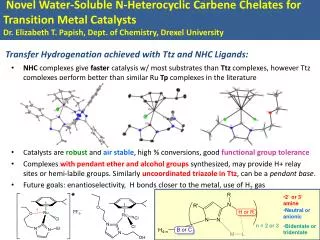
Dr. Elizabeth T. Papish's research at Drexel University focuses on novel water-soluble N-heterocyclic carbene chelates for transition metal catalysts. These catalysts show improved performance in transfer hydrogenation, offering robustness, air stability, and excellent functional group tolerance. The complexes synthesized with pendant ether and alcohol groups hold promise for enhancing catalytic activity. Future directions include achieving enantioselectivity, utilizing H2 gas, and exploring the coordination of secondary or tertiary amines in neutral or anionic forms.

Water-Soluble N-Heterocyclic Carbene Chelates for Efficient Transition Metal Catalysis
E N D
Presentation Transcript
Novel Water-Soluble N-Heterocyclic CarbeneChelates for Transition Metal Catalysts Dr. Elizabeth T. Papish, Dept. of Chemistry, Drexel UniversityTransfer Hydrogenation achieved with Ttz and NHC Ligands: • NHCcomplexes give faster catalysis w/ most substrates than Ttz complexes, however Ttz complexes perform better than similar RuTp complexes in the literature • Catalysts are robust and air stable, high % conversions, good functional group tolerance • Complexes with pendant ether and alcohol groups synthesized, may provide H+ relay sites or hemi-labile groups. Similarly uncoordinated triazole in Ttz, can be a pendant base. • Future goals: enantioselectivity, H bonds closer to the metal, use of H2 gas • 2˚ or 3˚ amine • Neutral or anionic • Bidentate or tridentate