Reductive Dechlorination: Mechanisms and Impacts on Environmental Remediation
Reductive dechlorination is a critical process involving electron transfer, primarily addressing halogenated hydrocarbons. This process, enhanced by zero-valent iron, allows for the reduction of harmful compounds. Notably, hydrogen gas, usually inert, can facilitate hydrodehalogenation in the presence of catalysts like Pd, Ni, or Pt. While reducing contaminants like nitrates to nitrogen gas can be beneficial, a significant long-term issue arises: as dehalogenation occurs, the pH increases, potentially leading to precipitation of compounds like CaCO3, thereby reducing barrier porosity.

Reductive Dechlorination: Mechanisms and Impacts on Environmental Remediation
E N D
Presentation Transcript
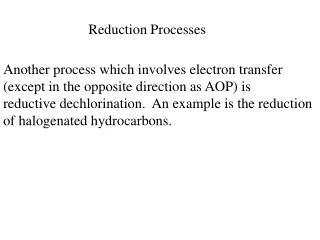
Reduction Processes Another process which involves electron transfer (except in the opposite direction as AOP) is reductive dechlorination. An example is the reduction of halogenated hydrocarbons.
Hydrogen gasis usually inert but in the presence of Pd, Ni, Pt and possibly Feo hydrodehalogenation is possible. It is also possible that Feo can react with H+ to form H2.
Other chemical species can be reduced by the iron. For example nitrate can be reduced to nitrogen gas:
Potential long term problem: As the dehalogenation process proceeds pH will rise as H+ is used. This could result in precipitation of CaCO3 or FeCO3 which will ultimately reduce porosity of the permeable barrier.
Typical Design Results: First order decay rate approx. 0.03 per hour ( half life = 20 hours) With a Feo barrier of 1.2 m thickness and a flow rate through the barrier equal to 0.4 m/day get approx. 90% reduction in RX.