Download
1 / 1
10 likes | 121 Vues
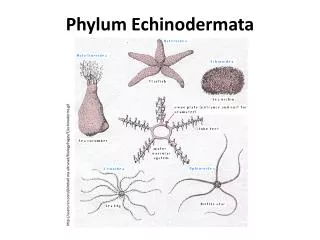
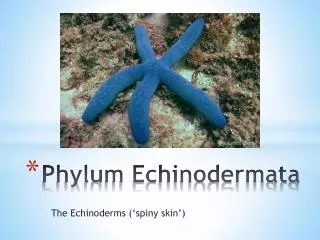
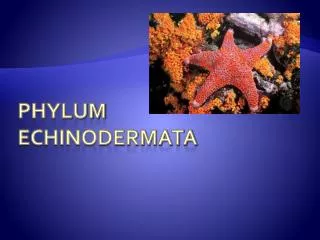
Echinoderms are unique marine invertebrates characterized by their radial symmetry and endoskeleton. This guide covers essential terminology related to echinoderms, including pedicellaria, ossicles, madreporite, and the water-vascular system, which is crucial for locomotion and feeding. You'll learn about specific structures like the radial canal and ampulla, the functioning of the tube foot, and the digestive process involving the cardiac and pyloric stomachs. Also covered is the bipinnaria larva stage, highlighting the fascinating life cycle of these organisms.

E N D
Phylum Echinodermata Vocab 1. Echinoderm-a radially symmetrical marine invertebrate that has an endoskeleton 2. Pedicellaria- on the surface of some echinoderms, very small pincers that are used for protection against ectoparasites 3. Ossicle- one of the small, calcium carbonate plates that make up the endoskeleton of an echinoderm 4. Madreporite- porous structure through which water enters and exits the water-vascular system of echinoderm 5. Water-vascular system- system of canals filled with a watery fluid that circulates throughout the body of echinoderms 6. Radial canal- extends from the ring canal to the end of each arm of a sea star 7. Ampulla- a bulblike sac that is created as the upper end of the tube foot is expanded 8. Tube foot- connects to a pair of digestive glands in each arm of a sea star 9. Cardiac stomach- can be turned inside out through the mouth of a starfish; transfers food to the pyloric stomach 10. Bipinnaria- the larva of a starfish