SlideServe
Menu
Préférences
© SlideServe · v2026

Comparative Study of Peptide-MHC Binding Predictions

vernon-beasley avatar
8 diapositives · 192 Views · Nov 08, 2014

This project involves comparing methods for peptide-MHC binding predictions, including PSSM, ANN, and HMM. The study evaluates various approaches, such as position-specific scoring matrices and artificial neural networks with different encoding schemes. By analyzing the performance of each method against a benchmark dataset, researchers aim to enhance the accuracy of MHC binding predictions. The project includes method development, training, evaluation, and documentation in a research article format.
Comparative Study of Peptide-MHC Binding Predictions - slide 1
01 / 8Comparative Study of Peptide-MHC Binding Predictions
1 / 17

Télécharger la présentation

Comparative Study of Peptide-MHC Binding Predictions
Une image / un lien ci-dessous est fourni (tel quel) pour télécharger la présentation

Politique de téléchargement : le contenu du site vous est fourni TEL QUEL pour votre information et votre usage personnel ; il ne peut être vendu, concédé sous licence ni partagé sur d’autres sites sans l’accord de son auteur.Le contenu vous est fourni TEL QUEL, pour votre information et votre usage personnel uniquement. Téléchargez la présentation en cliquant sur ce lien. Lors du téléchargement, si vous ne parvenez pas à télécharger une présentation, l’éditeur a peut-être supprimé le fichier de son serveur.Pendant le téléchargement, si vous ne parvenez pas à obtenir une présentation, le fichier a peut-être été supprimé par l’éditeur.

F I N

Plus de contenu associé

Transcription de la présentation
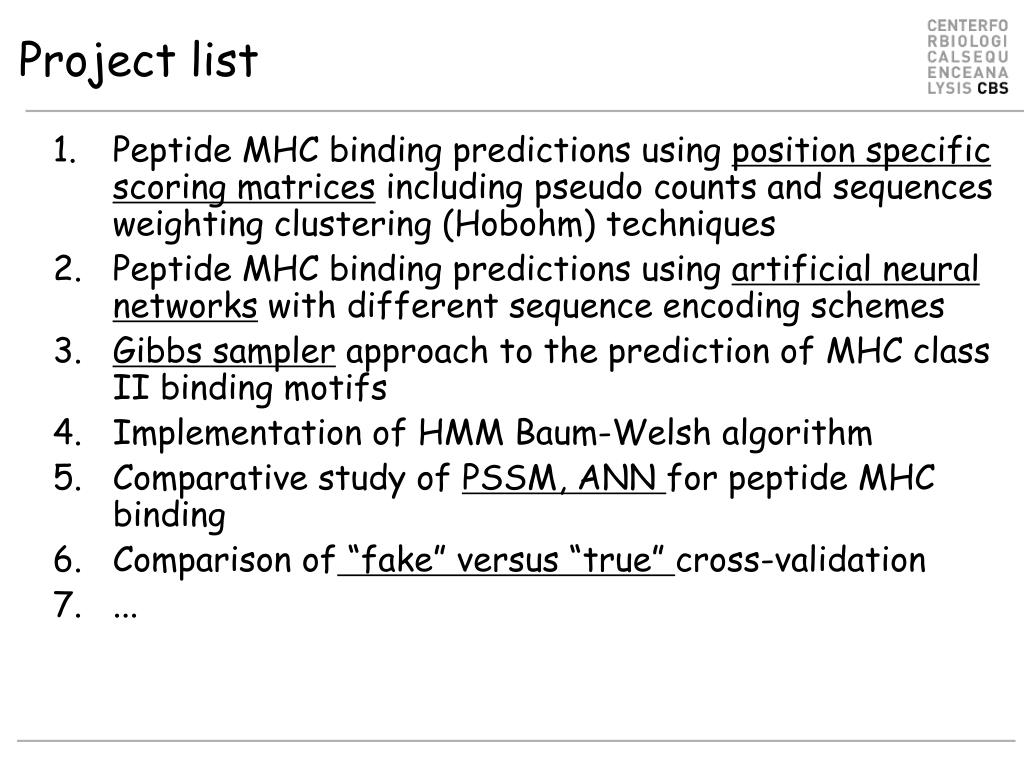
  1. Project list • Peptide MHC binding predictions using position specific scoring matrices including pseudo counts and sequences weighting clustering (Hobohm) techniques • Peptide MHC binding predictions using artificial neural networks with different sequence encoding schemes • Gibbs sampler approach to the prediction of MHC class II binding motifs • Implementation of HMM Baum-Welsh algorithm • Comparative study of PSSM, ANN for peptide MHC binding • Comparison of “fake” versus “true” cross-validation • ...

  2. What is a Project • Purpose • Use a method introduced in the course to describe some biological problem • How • Construct a data set describing the problem • Define which method to use • (Develop method) • Train and evaluate method • (Compare performance to other methods) • Documentation • Write report in form of a research article (10-15 pages) • Abstract • Introduction • Materials and method • Results • Discussion • References

  3. PSSM • Peptide MHC binding predictions using position specific scoring matrices including pseudo counts and sequences weighting techniques • Compare methods for sequence weighting • Clustering vs heuristics • Benchmark (Peters et al 2006) covering some 20 MHC molecules, compare to best other methods • Data are at • http://mhcbindingpredictions.immuneepitope.org/dataset.html • Use IC50 = 500 nM as threshold for binders when making PSSM

  4. NN • Peptide MHC binding predictions using artificial neural networks with different sequence encoding schemes • Benchmark (Peters et al 2006) covering some 20 MHC molecules, compare to best other methods • Compare sequence encoding schemes • Sparse, Blosum, composition, charge, amino acids size,.. • AA index database of amino acid physicochemical properties • http://www.genome.jp/aaindex/AAindex

  5. Gibbs sampler • Gibbs sampler approach to the prediction of MHC class II binding motifs • Develop Gibbs sampler to prediction of MHC class II binding motifs • Benchmark Nielsen et al 2007 covering 14 HLA-DR alleles • http://www.cbs.dtu.dk/suppl/immunology/NetMHCII-2.0.php • Use IC50 = 500 nM (log50k = 0.426) as threshold for binders

  6. Comparative study • Compare methods for MHC peptide binding • PSSM • ANN • Data: Benchmark by Peters et al 2006 covering some 20 MHC molecules

  7. HMM • Implement Baum-Welsh HMM training • Based on code from Tapas Kanungo HMM toolkit • Hidden Markov Model (HMM) Software: Implementation of Forward-Backward, Viterbi, and Baum-Welch algorithms. The software has been compiled and tested on UNIX platforms (sun solaris, dec osf and linux) and PC NT running the GNU package from Cygnus (has gcc, sh, etc.). A tar file can be found at: (tar file). If you need a zip file: zip file . The README file. Postscript slides for tutorial talks that I gave on HMM. The PDF version of the tutorial. • Test code on un-fair casino example

  8. Method evaluation using cross-validation • Compare performance of data-driven prediction methods when evaluated using cross-validation • What is the difference between the “fake” and “true” cross-validated performance as a function of • Data set size • .. • Data: Benchmark by Peters et al. 2006 covering some 20 MHC molecules