Earth's History: From Life's Origins to Impact Events
Explore the fascinating timeline of Earth's history, focusing on the origins of life over 3.6 billion years ago and the significant events that shaped our planet, including mass extinctions caused by extraterrestrial impacts. Learn about the stability of seawater composition, the importance of intertidal zones, and historical impact craters, such as the one linked to the extinction of the dinosaurs at the K/T boundary. Discover the evolution of life, geological changes, and how these events continue to shape Earth today.


Earth's History: From Life's Origins to Impact Events
E N D
Presentation Transcript
S EARTH ORIGIN
P % of Earth’s History * 78.0% 43.0% 9.3% 8.0% 3.8% 0.1%
S Order of Planets from the Sun Sizes are Relative Distances are not Accurate
S Order of Planets from the Sun Sizes are Relative Distances are not Accurate
S Milky Way Galaxy
S TIME-LAPSE VIDEO OFNIGHT SKY IN NAMIBIAhttp://www.youtube.com/watch?v=EM5lM5WEY3Q
P http://www.youtube.com/watch?v=oAVjF_7ensg
S Decay Products of U235
P Half-life = the time it takes for half of the parent to decay into the daughter
P Long half-life Slow Processes Short half-life Fast Processes
P Earth’s Atmosphere Changes
S Life on Earth • Earliest known evidence of life was about 3.6 billion years ago • Early life may have started in the intertidal zone or at black smokers
S Intertidal Algae
P Life on Earth • Evidence suggest the composition of seawater has changed little over the last 600 million years • Mass extinctions have occured over time. Why?
S Moon Craters
S Impact Craters in Canada
S Most impact craters would be in the oceans
P 7/18/94 19:35 GMT +7 min + 16 min
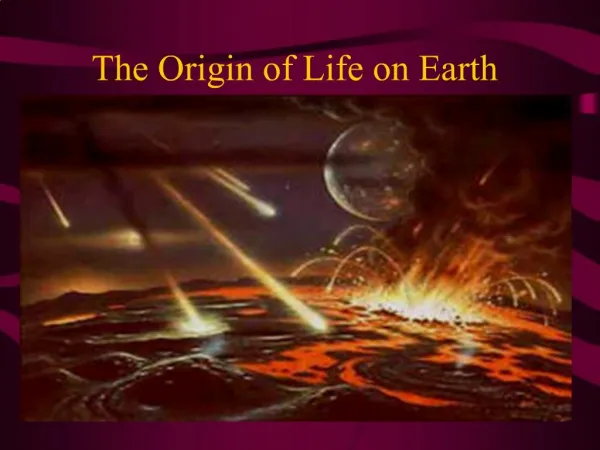
P Life on Earth • Impacts from extraterrestrial bodies • the latest big one was at the K/T boundary about 66 million years ago • it corresponds with the extinction of the dinosaurs • in 1991 bull’s eye pattern of gravity variations was detected off northern Yucatan (Chicxulub) • the circle was 180 km in diameter
P Life on Earth • other more recent events include: • Winslow, Arizona about 50,000 years ago leaving a crater 4,000’ wide and 750’ deep - caused by an object 135’ in diameter traveling at 12 miles a second with an explosive force of 15 megatons • Tunguska, Siberia - 1908 - no crater, extensive damage, 10 megatons, site not visited for 20 years
S Meteorite Crater near Winslow, Arizona