Basic Ruby Syntax
Explore the fundamentals of Ruby programming, including variable declarations, control structures, methods, and data types. Learn how to manipulate strings, arrays, and hashes, and understand key concepts like scope and blocks. This summary provides an overview of essential Ruby syntax, demonstrating how to use loops, conditionals, and functional programming techniques efficiently. Whether you're a beginner looking for a solid introduction or brushing up on your skills, these notes will guide you through the powerful Ruby language.

Basic Ruby Syntax
E N D
Presentation Transcript
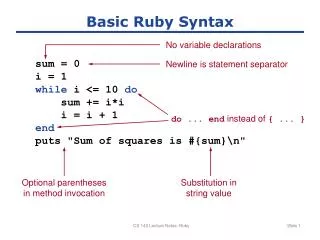
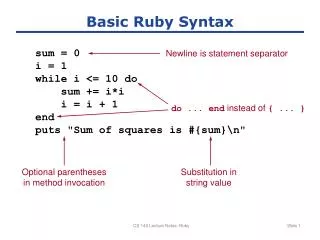
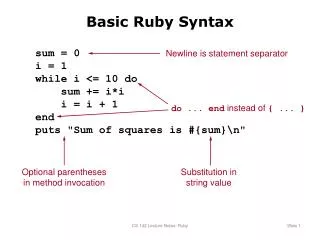
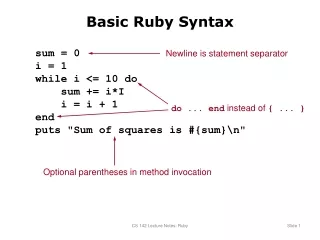
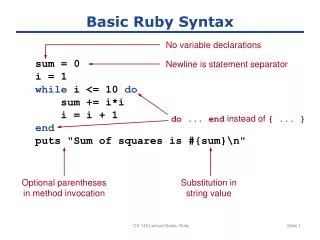
Basic Ruby Syntax No variable declarations sum = 0 i = 1 whilei <= 10 do sum += i*i i = i + 1 end puts "Sum of squares is #{sum}\n" Newline is statement separator do ... end instead of { ... } Optional parentheses in method invocation Substitution instring value CS 142 Lecture Notes: Ruby
Ruby String Syntax • Single quotes (only \' and \\) 'Bill\'s "personal" book' • Double quotes (many escape sequences) "Found #{count} errors\nAborting job\n" • %q (similar to single quotes) %q<Nesting works: <b>Hello</b>> • %Q (similar to double quotes) %Q|She said "#{greeting}"\n| • “Here documents” <<END First line Second line END CS 142 Lecture Notes: Ruby
Arrays and Hashes x = Array.new x << 10 x[0] = 99 y = ["Alice", 23, 7.3] x[1] = y[1] + y[-1] person = Hash.new person["last_name"] = "Rodriguez" person[:first_name] = "Alice" order = {"item" => "Corn Flakes", "weight" => 18} order = {:item => "Corn Flakes", :weight => 18} order = {item: "Corn Flakes", weight: 18} CS 142 Lecture Notes: Ruby
Variable Names and Scopes foo Local variable $foo Global variable @foo Instance variable in object @@foo Class variable MAX_USERS “Constant” (by convention) CS 142 Lecture Notes: Ruby
Ruby Statements if x < 10 then ... elsifx < 20 ... else ... end while x < 10 do ... end array = [14, 22, 34, 46, 92] for value in array do ... end CS 142 Lecture Notes: Ruby
Factorial deffac(x) if x <= 1 then return 1 end return x*fac(x-1) end CS 142 Lecture Notes: Ruby
Arguments: Defaults, Variable # definc(value, amount=1) value+amount end defmax(first, *rest) max = first for x in rest do if (x > max) then max = x end end return max end CS 142 Lecture Notes: Ruby
Keyword Arguments defcreate_widget(size, properties) ... end create_widget(6, {:id => "table22", :class => "Cart"}) create_widget(6, :id => "table22", :class => "Cart") create_widget(6, id: "table22", class: "Cart") CS 142 Lecture Notes: Ruby
Blocks, Iterators, Yield odd_numbers(3) do |i| print(i, "\n") end defodd_numbers(count) number = 1 while count > 0 do yield(number) number += 2 count -= 1 end end Block: code passedto method Invoke method’s block CS 142 Lecture Notes: Ruby
Iterators are Reusable defsum_odd(count) sum = 0 odd_numbers(count) do |i| sum += i end return sum end defodd_numbers(count) number = 1 while count > 0 do yield(number) number += 2 count -= 1 end end CS 142 Lecture Notes: Ruby
Equivalent Code array = [14, 22, 34, 46, 92] for value in array do print(value, "\n") end array = [14, 22, 34, 46, 92]; array.eachdo |value| print(value, "\n") end CS 142 Lecture Notes: Ruby
Simple Class class Point definitialize(x, y) @x = x @y = y end defx @x end defx=(value) @x = value end end p = Point.new(3,4) puts "p.x is #{p.x}" p.x= 44 CS 142 Lecture Notes: Ruby
Module Example New methods available in MyClass: min, max, sort, map, select, ... classMyClass include Enumerable ... defeach ... end end CS 142 Lecture Notes: Ruby