
SlideServe
Menu
Préférences
© SlideServe · v2026

Antacids

vilina avatar
18 diapositives · 675 Views · Aug 04, 2014

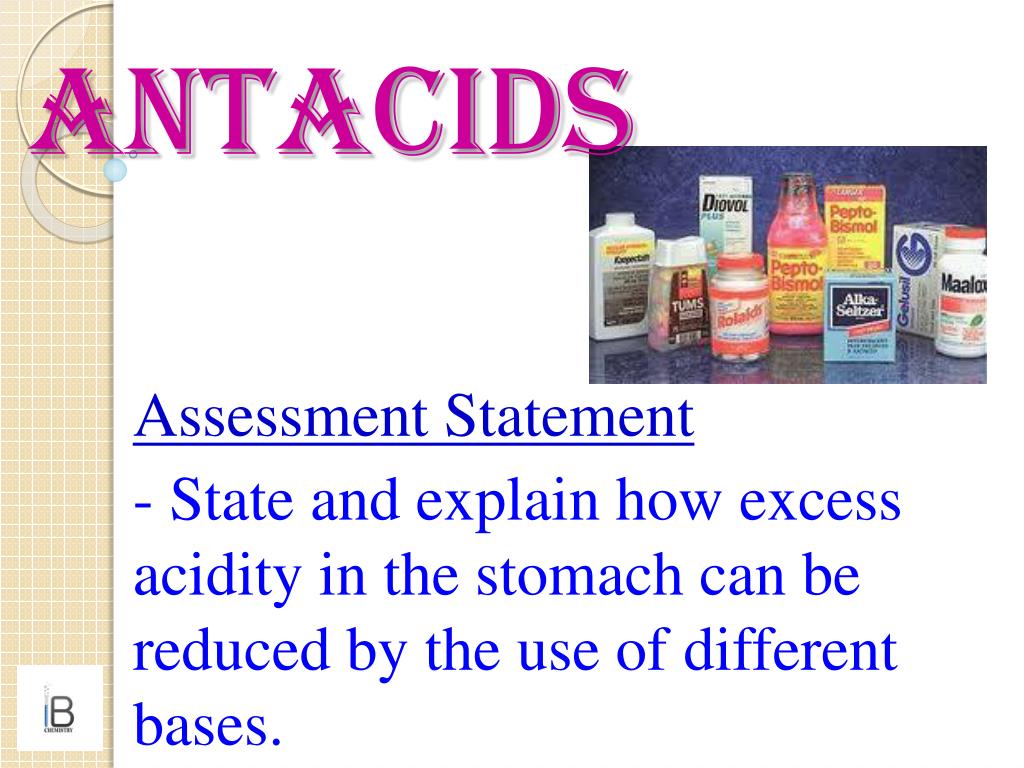
Antacids. Assessment Statement - State and explain how excess acidity in the stomach can be reduced by the use of different bases. Stomach Acidity. Stomach cells secrete hydrochloric acid ( HCl )  providing an acidic environment (pH of 1-2) Benefits of acidic environment:
Antacids - slide 1
01 / 18Antacids
1 / 17

Télécharger la présentation

Antacids
Une image / un lien ci-dessous est fourni (tel quel) pour télécharger la présentation

Politique de téléchargement : le contenu du site vous est fourni TEL QUEL pour votre information et votre usage personnel ; il ne peut être vendu, concédé sous licence ni partagé sur d’autres sites sans l’accord de son auteur.Le contenu vous est fourni TEL QUEL, pour votre information et votre usage personnel uniquement. Téléchargez la présentation en cliquant sur ce lien. Lors du téléchargement, si vous ne parvenez pas à télécharger une présentation, l’éditeur a peut-être supprimé le fichier de son serveur.Pendant le téléchargement, si vous ne parvenez pas à obtenir une présentation, le fichier a peut-être été supprimé par l’éditeur.

F I N

Plus de contenu associé

Transcription de la présentation
  1. Antacids Assessment Statement - State and explain how excess acidity in the stomach can be reduced by the use of different bases.

  2. Stomach Acidity Stomach cells secrete hydrochloric acid (HCl)  providing an acidic environment (pH of 1-2) Benefits of acidic environment: • kill bacteria • provide optimum pH for digestive enzymes (ex. Pepsin)

  3. - IB Questions Q: Identify the substance responsible for low pH of the liquid in the stomach A: hydrochloric acid

  4. Stomach Acidity Excess Stomach Acidity Cause: alcohol, smoking, stress, anti- inflammatory drugs Outcomes: acid indigestion – discomfort feeling from too much acid heartburn – acid rising into the esophagus (acid reflux) ulcer – damage to the lining of the stomach wall, results in tissue loss and inflammation http://www.youtube.com/watch?v=EXGHpXlBgZA&safety_mode=true&persist_safety_mode=1&safe=active

  5. - IB Questions Q: Explain how heartburn is caused A: Heartburn is caused by the acid rising up to the esophagus

  6. What is Antacids? • drugs that work to neutralizeHCl in the stomach • relieve discomforts • adjustthe pH of the stomach to the desire level of acidity

  7. Compounds of Antacids • all compounds of antacids are WEAK BASIC Compounds/Ingredients: - metal oxides - metal hydroxides { Al(OH)3 , Mg(OH)2 } - carbonates { CaCO3 } - hydrocarbonates { NaHCO3 }

  8. Compounds of Antacids metal oxides/ hydroxides + HCl salt + H2O carbonates/ hydrocarbonates +HCl  salt + H2O + CO2

  9. Neutralization of HCl Examples: 1. magnesium oxide 2. magnesium hydroxide 3. aluminum hydroxide 4. calcium carbonate 5. sodium hydrocarbonate Remember to balance the equations!!!

  10. Neutralization of HCl • MgO + 2HCl  MgCl2+ H2O • Mg(OH)2 + 2HCl  MgCl2 + 2H2O • Al(OH)3 + 3HCl  AlCl3 + 3H2O • CaCO3 + 2HCl  CaCl2 + H2O + CO2 • NaHCO3 + HCl  NaCl + H2O + CO2

  11. - IB Questions Q: What are the metals that used in antacids? A: aluminum, calcium, magnesium, sodium

  12. Neutralization of HCl ***Notice the mole ratio of the reactions • the mole ratio determines the effectiveness when comparing compounds Neutralization of HCl with aluminum hydroxide is the most effective - Al can neutralize 3 moles of H+ ions / it has three OH- ions

  13. Antacid Formulations Can contains both magnesium and aluminum compounds Why both? - they act as complements of each others

  14. Antacid Formulations With metal carbonates and hydrocarbonates ..... .... the production of CO2 gas may cause bloating and flatulence CaCO3 + 2HCl  CaCl2 + H2O + CO2 NaHCO3 + HCl  NaCl + H2O + CO2

  15. Antacid Formulations Solutions: 1) antifoaming agents are added to relieve the side effects (ex. dimethicone) 2) ALGINATES are added to prevent reflux into the esophagus

  16. Health Hazard!!! High dose  a basic stomach – can cause discomforts, a condition called alkalosis Antacids are not always necessary …. …. frequent use can harmful to heart, kidney, or bones

  17. - IB Questions Q: Suggest why potassium hydroxide is not used as an antacid A: KOH is a strong base (alkali) so it would be dangerous for body cells; it is corrosive and would upset the pH

  18. The End!