Exploring Corporeal Space: The Experience of Videogame Spatiality and the Body
This presentation by Peter Bayliss delves into the disembodied ocularism influenced by Cartesian Dualism within the realm of videogames. It highlights the importance of spatial experiences in gaming, exploring how players can attain a sense of ‘presence’ in virtual worlds through limited visual, aural, and haptic feedback. Drawing on phenomenological theories from Merleau-Ponty and Heidegger, it investigates embodied interaction, interfaces, and the dynamic relationship between players and videogame spaces, ultimately addressing the critical role of embodied cognition.

Exploring Corporeal Space: The Experience of Videogame Spatiality and the Body
E N D
Presentation Transcript
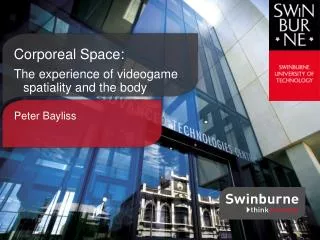
Peter Bayliss • Corporeal Space: • The experience of videogame spatiality and the body
Corporeal Space • Background • Based on final and summarising chapter of my doctoral research. • Broadly, addressing the disembodied occularism derived from an uncritical acceptance of Cartesian Dualism that informed many of the assumptions of the field of study, and videogame discourses more generally. • Importance of space in videogames. • So a lot to cover in 10 minutes!
Corporeal Space • The key question: • How can videogame players experience a sense of ‘presence’ within videogame worlds? • Limited representation and feedback through visual, aural, and haptic channels. • Yet, experienced as spaces that players can act and move within, explore, and in a sense inhabit.
Corporeal Space • Embodied Interaction • Paul Dourish (2001) “Where the Action Is: The Foundations of Embodied Interaction.” • Draws heavily on Merleau-Ponty’s “Phenomenology of Perception,” & Heidegger’s phenomenology of tool/equipment use in “Being and Time.” • Development of embodied cognition within the field of cognitive science.
Corporeal Space • Interfaces and the Body • Videogame interfaces are more than just the technological devices we use to interact with computing. • Interfaces as a relational concept, bringing into connection the player and the game. • Merleau-Ponty: The ability of the body to incorporate instruments into the bodily schema, and thus to extend the body.
Corporeal Space • The experience of videogame space • Videogames draw upon our already existing experience of everyday space, both immediate physical experience as well as cultural knowledges and understandings. • Importance of the capacity to ‘move’ through videogame space. • The affective work of playing videogames – bridging the ‘gap’ between the representation of videogame spaces and the experience of those spaces.
Corporeal Space: • The experience of videogame spatiality and the body • Peter Bayliss