SlideServe
Menu
Préférences
© SlideServe · v2026

Advancements in Nanoelectronic and Nanophotonic Characterization of Hybrid Materials

virgil avatar
2 diapositives · 163 Views · Aug 22, 2014

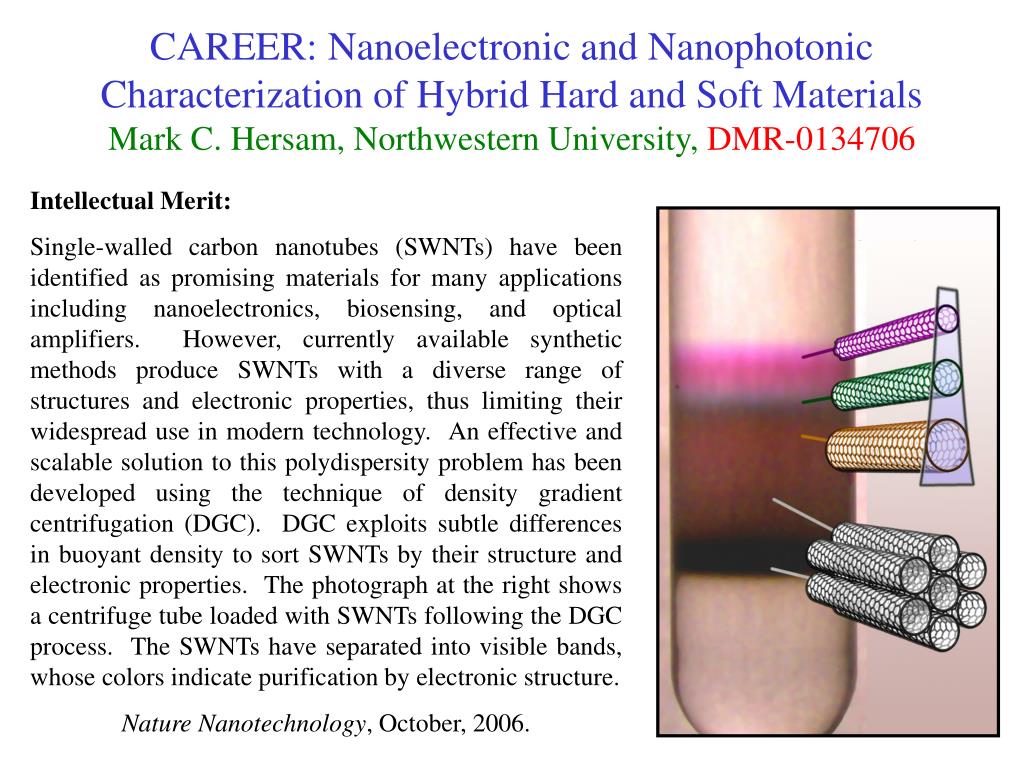
This project, led by Mark C. Hersam from Northwestern University, focuses on the characterization of single-walled carbon nanotubes (SWNTs), which are promising for applications in nanoelectronics and biosensing. The challenges posed by the diverse structures of SWNTs have been addressed using density gradient centrifugation (DGC), a method that sorts SWNTs based on their electronic properties. Additionally, the program "Undergraduate Projects in Nanoscale Engineering and Design" enables 40 students from various academic backgrounds to engage in cutting-edge nanoscale research.
Advancements in Nanoelectronic and Nanophotonic Characterization of Hybrid Materials - slide 1
01 / 2Advancements in Nanoelectronic and Nanophotonic Characterization of Hybrid Materials
1 / 17

Télécharger la présentation

Advancements in Nanoelectronic and Nanophotonic Characterization of Hybrid Materials
Une image / un lien ci-dessous est fourni (tel quel) pour télécharger la présentation

Politique de téléchargement : le contenu du site vous est fourni TEL QUEL pour votre information et votre usage personnel ; il ne peut être vendu, concédé sous licence ni partagé sur d’autres sites sans l’accord de son auteur.Le contenu vous est fourni TEL QUEL, pour votre information et votre usage personnel uniquement. Téléchargez la présentation en cliquant sur ce lien. Lors du téléchargement, si vous ne parvenez pas à télécharger une présentation, l’éditeur a peut-être supprimé le fichier de son serveur.Pendant le téléchargement, si vous ne parvenez pas à obtenir une présentation, le fichier a peut-être été supprimé par l’éditeur.

F I N

Plus de contenu associé

Transcription de la présentation
  1. CAREER: Nanoelectronic and NanophotonicCharacterization of Hybrid Hard and Soft MaterialsMark C. Hersam, Northwestern University, DMR-0134706 Intellectual Merit: Single-walled carbon nanotubes (SWNTs) have been identified as promising materials for many applications including nanoelectronics, biosensing, and optical amplifiers. However, currently available synthetic methods produce SWNTs with a diverse range of structures and electronic properties, thus limiting their widespread use in modern technology. An effective and scalable solution to this polydispersity problem has been developed using the technique of density gradient centrifugation (DGC). DGC exploits subtle differences in buoyant density to sort SWNTs by their structure and electronic properties. The photograph at the right shows a centrifuge tube loaded with SWNTs following the DGC process. The SWNTs have separated into visible bands, whose colors indicate purification by electronic structure. Nature Nanotechnology, October, 2006.

  2. Benjamin Levy, undergraduate participant in the Undergraduate Projects in Nanoscale Engineering and Design Program, is using a Secondary Ion Mass Spectrometer with the assistance of staff member, Nick Wu. CAREER: Nanoelectronic and NanophotonicCharacterization of Hybrid Hard and Soft MaterialsMark C. Hersam, Northwestern University, DMR-0134706 Broader Impacts: With leveraged funding from the philanthropic Murphy Society, a new program has been developed entitled “Undergraduate Projects in Nanoscale Engineering and Design.” This program is designed to facilitate interdisciplinary undergraduate research projects by providing access and training to the state-of-the-art tools and techniques offered by the Northwestern University Atomic and Nanoscale Character-ization Experimental (NUANCE) User Facility. Over the past three years, 40 undergraduates from 8 different academic departments have conducted innovative nanoscale engineering and design projects under the auspices of this program. In an effort to disseminate the results of these projects, the final student reports are publicly available on the internet at the NUANCE web page.