The Giant Panda
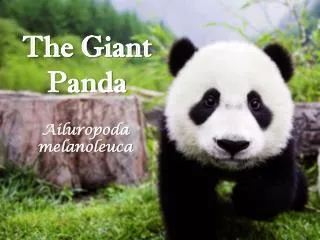
The Giant Panda, scientifically known as Ailuropoda melanoleuca, is a remarkable bear species native to China's mountainous regions. Weighing up to 250 lbs, these black and white bears are classified under the Mammalia class and are currently endangered due to decreasing populations. Pandas primarily feed on bamboo, spending up to 14 hours a day foraging for it. Breeding is seasonal, with females giving birth to 1-2 cubs. Conservation efforts aim to raise panda populations to 5,000 by 2025. Learn more about their habitat, diet, and the challenges they face in the wild.
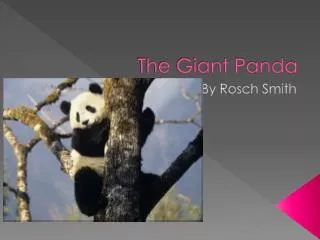

The Giant Panda
E N D
Presentation Transcript
The Giant Panda By Rosch Smith
Classification • Scientific name: Ailuropoda melanoleuca • Kingdom: Animalia • Phylum: Chordata • Class: Mammalia • Order: Carnivora • Family: Ursidae • Genus: Ailuropoda • Species: Ailuropoda melanoleuca
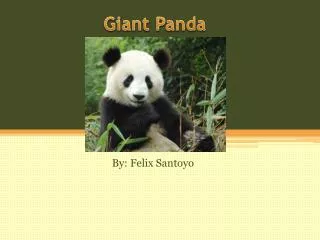
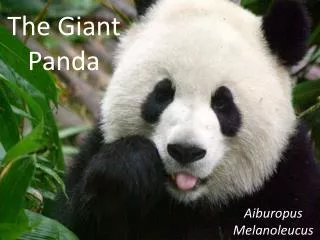
Physical Characteristics MaleFemale Weight: up to 250 Lbs. Rarely reach 220 Lbs. Appearance: They both are like a black and white bear.
Habitat All giant pandas live in mountainous ranges and some valleys in china.
Conservation • The ICUN red list said that the Giant Panda is endangered and is decreasing.
Reproduction • The panda courtship and mating period are seasonal. During this period they become more vocal. They will sometimes if there restless, put there cent on trees and the ground. 2-5 males may compete for a single female. A female usually gives birth to 1-2 young. If she gives birth to 2 then one will usually dies.
Parental care • Young pandas usually leave there parents at about 18 months. The mother is the only one who cares for there young.
Longevity and mortality • In the wild the pandas have few predators except for humans. Baby pandas can be attacked by leopards. When its 2 it will probably not be attacked. In the wild the panda lives until 14 but in captivity they never live to exceed 30 years old.
Seasonal patterns • The panda does not change its attitude and the panda moves when it gets to cold or to hot where it is.
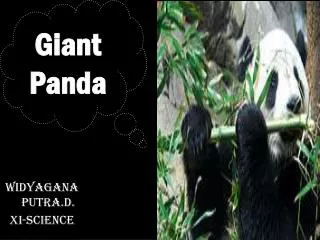
Diet • Their diet is Bamboo which we all know. Pandas actually eat 14 hours a day. 12 hours is spent gathering. The other 2 hours are spent travelling.
Predator relationships • Pandas don’t really have any predators except for when they are babies but the only predator is humans.
Human relationships • The panda does not really hurt human it is actually nice unless your going after her cub but other than that there pretty mellow.
Fun facts • There's less than 1000 left in the world. • Scientists want to try to increase them to 5000 by 2025. • There as big as a stick of butter when born. • Giant pandas may be fat but are good climbers. • Pandas are actually really playful.
Works cited • Facts.randomhistory.com/giant-panda-facts.html. Schaller, George B., Apr. 1992. Web. 12 Apr. 2013. <http://facts.randomhistory.com/giant-panda-facts.html>. • Indianchild.com/panda.htm. N.p., 7 11 2007. Web. 24 Mar. 2013. <http://www.indianchild.com/panda.htm>. • Nationalzoo.si.edu/animals/giantpandas/pandafacts/default. Smithsonian, n.d. Web. 26 Feb. 2013. <http://nationalzoo.si.edu/animals/giantpandas/pandafacts/default.cfm>.