Understanding Congenital Heart Disease: Types, Pathogenesis, and Clinical Features
Congenital Heart Disease (CHD) is the most common type of heart disease affecting children, with Ventricular Septal Defect (VSD) being the most prevalent anomaly. CHD has multifactorial etiology, with genetic factors like Down syndrome and environmental influences such as congenital rubella playing crucial roles. Clinical features differ based on shunt mechanisms leading to either cyanotic or acyanotic conditions. This overview covers the pathogenesis, clinical manifestations, and distinctions between left-to-right and right-to-left shunts, aiding in understanding and managing this critical health issue.

Understanding Congenital Heart Disease: Types, Pathogenesis, and Clinical Features
E N D
Presentation Transcript
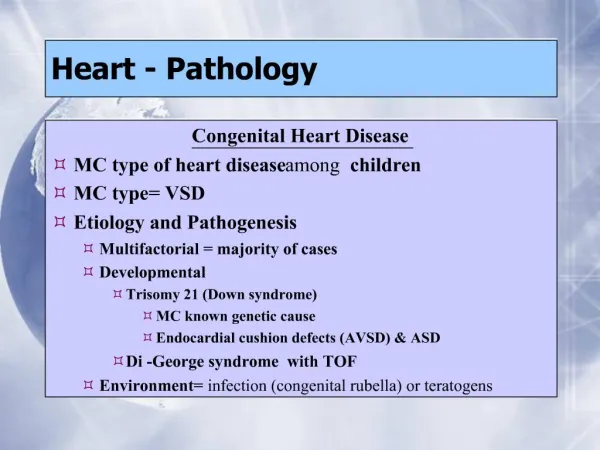
1. Heart - Pathology Congenital Heart Disease
MC type of heart disease among children
MC type= VSD
Etiology and Pathogenesis
Multifactorial = majority of cases
Developmental
Trisomy 21 (Down syndrome)
MC known genetic cause
Endocardial cushion defects (AVSD) & ASD
Di -George syndrome with TOF
Environment= infection (congenital rubella) or teratogens
2. Heart - Pathology Congenital Heart Disease
Clinical Features
Malformations causing
left-to-right shunt
right-to-left shunt
Obstruction
Mechanisms - left-to-right shunt
3. Heart - Pathology Congenital Heart Disease
Mechanisms - right-to-left shunt
4. Heart - Pathology Congenital Heart Disease
Mechanisms - others
5. Heart - Pathology Congenital Heart Disease
Left-to-right shunts
ASD, VSD, and Patent Ductus Arteriosus [PDA]
Congenitally acyanotic
Late cyanotic congenital heart disease or Eisenmenger syndrome
ASD
MC congenital cardiac anomaly asymptomatic until adulthood
Secundum ASD =90% of all ASDs
Defect is due to deficient or fenestrated oval fossa
Volume hypertrophy of RA & RV
Pulmonary blood flow - 2 to 4 times normal
Murmur at pulmonary area
Complications = uncommon
Normal postoperative survival
6. Heart - Pathology Congenital Heart Disease
VSD
Most common congenital cardiac anomaly (42%)
Spontaneously close in half of patients
? rd are associated with other defects (TOF)
clinically = Size is most critical
Morphology
Membranous VSD(90%)
Swiss-cheese septum =Multiple muscular septum VSDs
Right ventricular hypertrophy and pulmonary hypertension are present from birth
Rx = Surgical closure indicated at age 1 year with large defects
7. Heart - Pathology Congenital Heart Disease
PDA
Majority are isolated defects (90%)
Others (10%)-associated with VSD, COA, or PS, AS
No functional difficulties at birth & childhood
Continuous harsh machinery-like murmur
PDA is Life-threatening or life-saving
prostaglandin E ? preservation of ductal patency
? Drug closes PDA
AVSD
(endocardial cushion defect )
Superior & inferior endocardial cushions fail to fuse
? Inadequate formation of the AV valves
MC with Down syndrome
8. Heart - Pathology Congenital Heart Disease Right to left shunts Tetralogy of Fallot - MC cyanotic congenital heart disease Transposition of the great arteries Tricuspid atresia Total anomalous pulmonary venous connection Truncus Arteriosus