Controlling Water: Agriculture and Civilization in Ancient Mesopotamia
As a farmer in Southwest Asia 6,000 years ago, you're challenged by the rich yet unpredictable waters of the Tigris and Euphrates rivers. While the fertile valley allows for the growth of wheat and dates, spring floods devastate your fields, and summer droughts threaten your crops. Learn how early Mesopotamians developed innovative irrigation systems to manage these waters. This agricultural advancement not only secured food surpluses but also laid the foundations for complex societies, trade, and division of labor in the region known as the Fertile Crescent.

Controlling Water: Agriculture and Civilization in Ancient Mesopotamia
E N D
Presentation Transcript
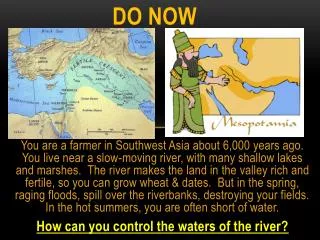
Do Now You are a farmer in Southwest Asia about 6,000 years ago. You live near a slow-moving river, with many shallow lakes and marshes. The river makes the land in the valley rich and fertile, so you can grow wheat & dates. But in the spring, raging floods, spill over the riverbanks, destroying your fields. In the hot summers, you are often short of water. How can you control the waters of the river?
CHAPTER 3 SECTION 1geography of the Fertile Crescent Big Idea:The valleys of the Tigris and Euphrates rivers were the site of the world’s first civilizations
Rivers & growth of civilizations • Region in Southwest Asia called Fertile Crescent • Extends from Persian Gulf to Mediterranean sea • Early civilizations of Mesopotamia (“Land between the rivers) depended on Tigris & Euphrates rivers • Silt fertilized river banks • Ideal for farming
Mesopotamians Ability to control floods • Used irrigation system to control raging spring floods & basins to store water. • Irrigation increased food surplus made people free to do other things (Division of Labor) • Cities became important for: • Trade, religious gatherings, & power based for leaders
Review • Fertile Crescent? • Mesopotamia? Silt? • Irrigation Systems? • Division of Labor?
Homework • Mesopotamia “Match Game” handout #1-25