Enhancing Ion Mobility and Mechanical Rigidity in Composite Electrolytes for Lithium-Ion Batteries
Researchers at the University of Michigan have discovered a relationship between ion migration rates and the mechanical stiffness of a polymeric network. This groundbreaking finding suggests that the structural conditioning of network materials can significantly enhance cation mobility, an essential property for solid-state electrolytes used in lithium-ion batteries. By employing sol-gel derived silica-based nano-porous materials and facilitating orientation through unidirectional solvent extraction, this study establishes new design criteria for improving battery performance.

Enhancing Ion Mobility and Mechanical Rigidity in Composite Electrolytes for Lithium-Ion Batteries
E N D
Presentation Transcript
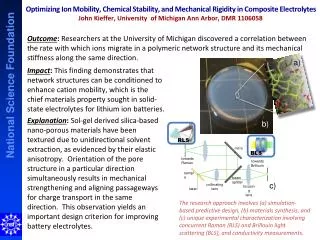
Optimizing Ion Mobility, Chemical Stability, and Mechanical Rigidity in Composite ElectrolytesJohn Kieffer, University of Michigan Ann Arbor, DMR 1106058 Outcome: Researchers at the University of Michigan discovered a correlation between the rate with which ions migrate in a polymeric network structure and its mechanical stiffness along the same direction. Impact: This finding demonstrates that network structures can be conditioned to enhance cation mobility, which is the chief materials property sought in solid-state electrolytes for lithium ion batteries. Explanation:Sol-gel derived silica-based nano-porous materials have been textured due to unidirectional solvent extraction, as evidenced by their elastic anisotropy. Orientation of the pore structure in a particular direction simultaneously results in mechanical strengthening and aligning passageways for charge transport in the same direction. This observation yields an important design criterion for improving battery electrolytes. a) BLS BLS RLS mirror towards Raman towards Brillouin b) sample beam splitter collimating lens focusing lens laser c) The research approach involves (a) simulation-based predictive design, (b) materials synthesis, and (c) unique experimental characterization involving concurrent Raman (RLS) and Brillouin light scattering (BLS), and conductivity measurements.