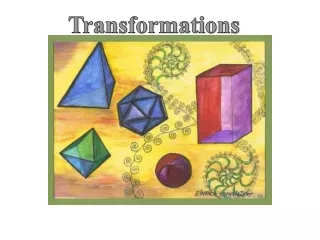
Transformations
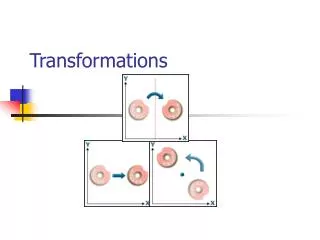
Transformational Geometry is a method of studying geometric figures through transformations, which include reflection, rotation, translation, and dilation. Each transformation alters the original figure, either preserving or changing characteristics such as size and orientation. Reflections create a mirror image across a line, rotations turn figures around a point, translations slide objects a fixed distance, and dilations modify size while maintaining shape. Learning these concepts helps in analyzing congruence, similarity, and other geometric properties.


Transformations
E N D
Presentation Transcript
Transformations Vocabulary
Transformational Geometry: • is a method for studying geometry that illustrates _____________________________________ by the use of transformations. • Transformation: A transformation of the plane is a ____________________________of points in the plane to points in the plane. congruence and similarity one to one mapping
Reflection • Reflection- is a transformation in which each point of the original figure (pre-image) has an image that is the ______________________________ • as the original point but is on the opposite side of the line. same distance from the line of reflection
Rotation • Rotation- is a transformation that ___________________________________ turns a figure about a fixed point called the center of rotation
Translation • Translation- is a transformation that ___________________________ direction. • A translation creates a figure that is ____________with the original figure. slides an object a fixed distance in a given congruent
Dilation • Dilation- is a transformation that produces an image that is the same shape as the original, but is a ____________. • A dilation ____________________ the original figure different size stretchesor shrinks
Describing transformations • Opposite Transformation: An opposite transformation is a transformation that ______________________of a figure. ___________are opposite transformations. • Image: An image is the ___________point or set of points under a transformation. • Pre-image: ____________ figure or set of points • Orientation: Orientation refers to the______________________, relative to one another, after a transformation has occurred. For example, the reference made to the direction traversed (clockwise or counterclockwise) when traveling around a geometric figure. changes the order Reflections resulting original arrangement of points
Isometry preserves length • Isometry: An isometry is a transformation of the plane that ____________________. • Direct: preserves _____________________ - the letters on the diagram go in the same clockwise or counterclockwise direction on the figure and its image. • Opposite: ___________________________________________ (such as clockwise changes to counterclockwise). • Vector: A quantity that has both_________________ • and __________; represented geometrically • by a directed line segment. orientation or order changes the order or orientation magnitude direction