Download
1 / 1
30 likes | 165 Vues
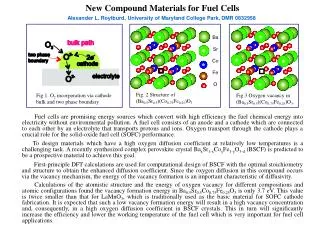
This study explores a newly synthesized complex perovskite material, Ba0.5Sr0.5Co0.75Fe0.25O3, for use in solid-oxide fuel cells (SOFCs). The research focuses on oxygen transport through the cathode, a critical factor in SOFC performance. Our first-principle DFT calculations reveal low vacancy formation energy (3.7 eV), promoting higher oxygen diffusion coefficients compared to traditional LaMnO3. This advancement is expected to significantly improve fuel cell efficiency and reduce operating temperatures, addressing critical challenges in fuel cell technology.

E N D
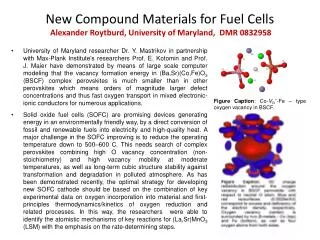
Ba Sr Co Fe O Alexander L. Roytburd, University of Maryland College Park, DMR 0832958 New Compound Materials for Fuel Cells Fig. 2 Structure of (Ba0.5Sr0.5)(Co0.75Fe0.25)O3 Fig 1. O2 incorporation via cathode bulk and two phase boundary Fig.3 Oxygen vacancy in (Ba0.5Sr0.5)(Co0.75Fe0.25)O3. Fuel cells are promising energy sources which convert with high efficiency the fuel chemical energy into electricity without environmental pollution. A fuel cell consists of an anode and a cathode which are connected to each other by an electrolyte that transports protons and ions. Oxygen transport through the cathode plays a crucial role for the solid-oxide fuel cell (SOFC) performance. To design materials which have a high oxygen diffusion coefficient at relatively low temperatures is a challenging task. A recently synthesized complex perovskite crystal BaxSr1-xCoyFe1-yO3-d (BSCF) is predicted to be a prospective material to achieve this goal. First-principle DFT calculations are used for computational design of BSCF with the optimal stoichiometry and structure to obtain the enhanced diffusion coefficient. Since the oxygen diffusion in this compound occurs via the vacancy mechanism, the energy of the vacancy formation is an important characteristic of diffusivity. Calculations of the atomistic structure and the energy of oxygen vacancy for different compositions and atomic configurations found the vacancy formation energy in Ba0.5Sr0.5Co0.75Fe0.25O3 is only 3.7 eV. This value is twice smaller than that for LaMnO3, which is traditionally used as the basic material for SOFC cathode fabrication. It is expected that such a low vacancy formation energy will result in a high vacancy concentration and, consequently, in a high oxygen diffusion coefficient in BSCF crystals. This in turn will significantly increase the efficiency and lower the working temperature of the fuel cell which is very important for fuel cell applications.