iii) Reptiles -Dinosaurs
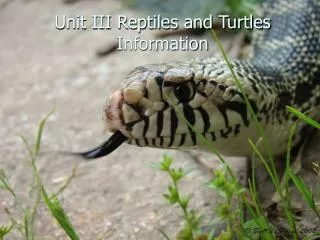
Reptiles, including dinosaurs, are diverse vertebrates dating back to the Triassic and Cretaceous periods. Originating from the Latin 'reptilis', meaning "creeping," reptiles comprise around 9,475 species across four primary groups: Crocodilia (alligators, crocodiles), Squamata (snakes, lizards), Testudines (tortoises, turtles), and Sphenodontia (tuataras). Cold-blooded with dry scaly skin, they lay amniote eggs and have a simple digestive system. Reptiles exhibit varied life cycles and reproducing strategies, such as oviparity and internal fertilization, and possess unique respiratory and circulatory systems.

iii) Reptiles -Dinosaurs
E N D
Presentation Transcript
iii) Reptiles-Dinosaurs By: Camila Rodriguez
Dinosaurs • Not the first reptile • Triassic period • Cretaceous period • Diapsid skull
Reason for the name # of species currently existing • From the Latin word 'reptilis' • Means 'creeping’ • 9,475 species • Divided in 4 groups: Crocodilia, Squamata, Testudines and Sphenodontia. • Crocodilia: alligators, crocodiles, caimans and gharials. • Squamata: Snakes and Lizards • Testudines: tortoises and turtles • Sphenodontia: tuataras
Squamata Crocodilia Testudines Sphenodontia
Reptile characteristics • Vertebrates=have backbone/internal skeleton • Cold blooded • Lay eggs on land (amnioteeggs) • Get oxygen from lungs • Dry scaly skin • Hatch into young adults • 3 chambered heart (alligators and crocodiles) • 2 aortic blood vessels • 4 or no legs • Internal fertilization
“Fossil record” • Oldest fossil 315 million years - Hylonomus (late Carboniferous period)
Life Cycle • Some lay their eggs and some give live birth. (oviparous) • Some reptiles stay with their parents when born • Grows becoming an adult • Female fertilize internally producing the eggs • They can reproduce more than once • After giving birth they die • Asexual reproduction
LifeExpactancy • Giant Tortoise: 152 years • Box Turtle 123 years • Alligator 68 years • Snapping Turtle 57 years • Cobra 28 years • Cottonmouth 21 years
Digestive System • Very simple • Mouth • Salivary gland- softens and moistens food • Esophagus- a tube in which the food goes from the pharynx to the stomach • Intestine- from stomach to anus • Cloaca- outlet intothe intestinal, urinary, and genital open • Eat • Most reptiles are carnivores feed on small invertebrates (mammals, reptile) • Some are herbivores feed on plant such as grasses, fruits, shrubs and marine plants.
Respiratory System • Breath using lungs • Gas exchange in reptiles occurs in the alveoli ( diaphragm) • Breathing occurs in a change in the volume of the body cavity. • Controlled by contraction of intercostalmuscles. • Turtles and tortoise • Ventilation of the lungs • sheets of muscle in the shell that, through contraction and relaxation, force air in and out of the lungs
Circulatory System • Closed system • 3 chambered hearts with two atria • Blood flows through heart • Mixing of oxygenated and deoxygenated blood
Sensory System • They feel pain, temperature, pressure, and stretching at the dermal level. • Crocodilia • Vertical cat-like pupil excellent diurnal / nocturnal vision • External ears • Eardrums • Nostril • Squamata • Eyelids- spectacle • Smell with their tongue • Ears • Testudines • smell • Ears: only hear vibrations and changes in water pressure • Night vision
Sensory System • Sphenodontia • Great vision • Third eye • Weak taste buds
Bibliography • http://staff.tuhsd.k12.az.us/gfoster/standard/breptil.htm • http://animals.about.com/od/zoologybasics/a/howmanyspecies.htm • http://cowgirljess.hubpages.com/hub/The-Four-Groups-of-Reptiles • http://honorsbiologyp6.wikispaces.com/Reptiles+-+Sensory+Systems • http://www.exoticpetvet.net/reptile/rerepro.html • http://www.britannica.com/EBchecked/topic/498684/reptile/38474/Digestive-and-urogenital-systems • http://www.sandiegozoo.org/animalbytes/t-lizard.html