Complex carbohydrates
This overview explores the various types of complex carbohydrates, including starches, cellulose, gums, and pectins. Starches, the most abundant complex carbohydrate in our diet, primarily come from sources like wheat, rice, corn, and potatoes. We also discuss the distinct structures of starches—amylose and amylopectin—and their properties. Moreover, we delve into other polysaccharides, such as pectins found in fruits, highlighting their roles as thickening agents in food. Understand how these compounds contribute to nutrition and food texture.

Complex carbohydrates
E N D
Presentation Transcript
Complex carbohydrates Ch 9 A
Types of complex carbohydrates • Starches • Cellulose • Gums • Pectins • others
Starches • Polymers of sugar • Most abundant complex carb in the diet • Most have 100 to several 1000 glucose units in chains
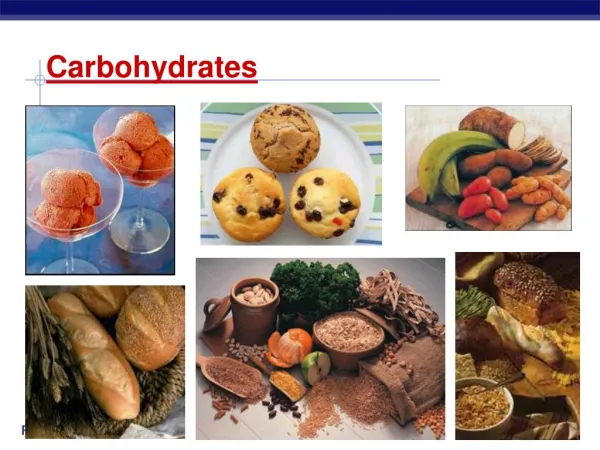
Starches ( cont) • Wheat is main source in the US • Also found in • rice, • corn, • potatoes, • and oats • Any grain or seed is high in starch.
Starches ( less commonly used) • Rye • Sorghum • Soy • Tapioca -is a starch extracted from cassava root. • Arrowroot- is an easily digested starch extracted from the roots of the arrowrootplant
Two basic structures of starch • Amylose- units are linked linear • Amylopectin- units have a branched structure
Starch is nature’s carb supply • Plants produce starches in packets called granules • Not soluble in cold water • Size and shape vary from plant to plant • Rice = smallest granule • Potato = largest granules • Varying starches varies performance of starches in foods • Starches with mainly amylopectin are called waxy starches
Cellulose • A polysacchride
polysaccharides • High molecular weight polymers or long chains of monosaccharide units • (Eg. cellulose and starch = polymers of glucose) • Form part of cellular structure and firmness of tissues • ( Eg. cellulose , pectins, and gums) • Energy reserve for animals and plants • (Eg. glycogen, starch)
Carbs: polysaccharides • Sources: • Seaweed • Microbial products • Plant exudates • Plants • Different from simple sugars: • Usually insoluble in water and tasteless
Carbohydrates: Polysaccharides • Agar* • Alginates* • Carrageenan* • Xanthan gum • Gum Arabic/ acacia gum • Pectins • Starch • Cellulose, hemicellulose * ( not in text materials)
Carbohydrates: polysaccharides • Agar, Alginates, Carrageenan • Extracted from seaweed • Suspending and thickening agents • Salad dressings, puddings, pie fillings, ice cream, sherbet and icings • Cocoa particles suspend in chocolate milk
Chocolate Milk • Purchase choc milk does not separate • Nestle Quick milk will separate
Carbohydrates: Polysaccharides ( other) • Xanthan gum • Extracted from bacteria (xanthomonascampestris) • From cabbage spoilage bacteria • Used to control viscosity ( thickness) • Used as a suspending agent ( salad dressing) • Provides Loaves structure in wheat-free bread
Carbohydrates: Polysaccharides ( other) • Gum Arabic ( acacia gum)* • Plant exudates from the bark of a certain tree (acacia trees) • Jelly beans: thickening agent • Beer : stabilizer for foam head *Expensive polysaccharide
Carbohydrates: Polysaccharides Pectins- C6H10O7 (polygalacturonic acid metyl ester) • Naturally found in plant tissue • Lemons, oranges, apples • Soft fruits not a good source • Considered a food additive GRAS • Generally regarded as safe • Used as jelling agents in jams and jellies • Hydrocolloidal that binds with water to create gel / thickener • Contribute to viscosity (resistance flow) of ketchup and tomato paste • Overall mouth feel of foods • Help maintain particles in suspension in OJ and unclarified apple juice
Lab: which fruits contain pectin? • Target: Observe the concentration and effect of pectin • Apple • Peach • Pear • Blue Berries • Grapes • Straw berry
Thickened Starch Mixtures • Types • • Sol—a thickened liquid • • Paste—thickened starch mixture that has little flow but is • spreadable • • Gel—a rigid starch mixture • Properties • • Retrogradation—gel becomes fi rm as it cools • • Syneresis—water leaks out of gel during storage • • Viscosity—resistance to flow • • Gelatinization—starch granules absorb water and swell, • causing thickening of liquids