Download

1 / 8
90 likes | 187 Vues
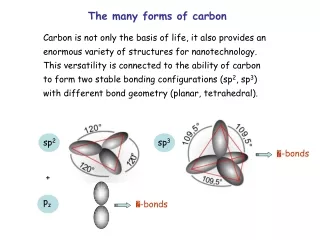
This overview delves into the various allotropes of carbon, including diamond, graphite, fullerene, and nanotubes. Diamond features strong sp³ bonds in a tetrahedral structure, making it extremely hard and an electrical insulator. Graphite consists of hexagonal sheets of graphene with delocalized electrons, providing electrical conductivity and lubricating properties. Fullerenes, like C60, exhibit unique closed cage structures, while carbon nanotubes, hollow cylinders of graphene, showcase remarkable strength and elasticity. Explore these fascinating carbon forms and their diverse properties.

E N D
Diamond • Covalent crystals: C, Si, Ge, SiC • Strong sp3s bonds form tetrahedral structure • Face Centered Cubic lattice (fcc) • 8 C atoms at the vertices of the cube, 6 C atoms in the face center, and 4 more within the unit cell • Each C is tetrahedrally bonded to four others • All C-C bonds 1.54 Ǻ • Properties • Extremely hard • Strong rigid structure (macromolecule) • Insulator • No delocalized e– (p bonds) • High index of refraction and strong dispersion of light Diamond film (CVD)
Graphite • Parallel sheets of graphene • Hexagonal, aromatic, “benzene” ring arrays • sp2s bonds stronger than in diamond • Delocalized p e– between sheets • Covalent-metal bond • Van der Walls forces between sheets • Randomly oriented graphite grains • Properties • Anisotropic • Electrical conductivity along sheets • Graphene: zero gap semi-conductor • Soft, greasy and lubricating • Strong absorption of light • On p e–
Fullerene • Richard Buckminster Fuller (1895 - 1993) • Bulk solid state: Fullerite • Closed cage C molecule • Pentagons in hexagonal structure • Isolated Pentagon Rule IPR (stress) • Spheroidal curvature • Admixture of sp3 hybridization • C60 • Diameter 7 Ǻ • With e 10Ǻ, cavity 4Ǻ • Hexagons (20) • Single bonds (red) 1.40 Ǻ • Double bonds (yellow) 1.46 Ǻ • Pentagons (12) • Single • Delocalized p e– • Mostly outside the cage • Higher density on double bonds • Influence of sp3 and curvature • Decreases with increasing n in Cn
1 2 3 Nanotube • Cylindrical C nanostructure • Graphene sheets wrapped into a cylinder • Armchair (1), zigzag (2), chiral (3) • sometimes capped by fullerene-like structure • Diameter: 1 to several nm • Length: 101mm • Single-walled carbon nanotubes SWCNT • Bundles (ropes) of tens SWCNT stuck in triangular lattice • Multi-walled carbon nanotubes MWCNT • Few to few tens of concentric cylinders • Spacing close to graphite 3.35 Ǻ • Toughest materials ever known • High elastic modulus of graphene sheets
sp2 sp2 pure sp2 pure sp3 Forms of Carbon