Understanding ASCII and EBCDIC Character Representation and Numerical Conversions
This article explores the character representation standards ASCII and EBCDIC, essential for converting textual information into binary format. It explains how each character is associated with binary numbers, highlighting the EBCDIC standard used in IBM systems and the ASCII standard used in most other computers. Additionally, the piece covers numerical conversions between uppercase and lowercase characters and control characters, providing practical methods for transforming characters using their binary representations and character codes.

Understanding ASCII and EBCDIC Character Representation and Numerical Conversions
E N D
Presentation Transcript
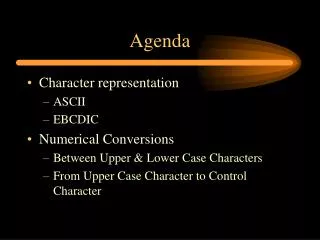
Agenda • Character representation • ASCII • EBCDIC • Numerical Conversions • Between Upper & Lower Case Characters • From Upper Case Character to Control Character
Character Representation • Since computers are only designed to interpret binary data, textual information must somehow be converted to binary. • In other words, a binary number is associated with each possible character
Character Representation There are two commonly recognized standards for data formats: • EBCDIC (Extended Binary Coded Decimal Interchange Code) • ASCII (American Standard Code for Information Interchange)
EBCDIC Characteristics: • Used on IBM mini and mainframe computers • 8 bit binary code associated with each character
ASCII Characteristics: • Used on most “other” computers. System designed from a variety of computer manufacturers • 7 bit code associated with each character • Also, an 8 bit code used to provide an additional 128 characters (additional character set - printable & nonprintable characters)
ASCII & EBCDIC Tables • We can represent various representation of characters by either standard by referring to tables. • Note that tables are organized as hexadecimal numbers for reference • Check my website for ASCII and EBCDIC Tables
Numerical Conversions (ASCII) • To convert uppercase character to lowercase character: • add 2016to uppercase characteror • add 3210 to uppercase character • To convert uppercase character to lowercase character: • subtract 2016to lowercase characteror • subtract 3210 to lowercase character
Uppercase Letter to Control Character • To convert uppercase character to corresponding control character • add 4016to uppercase characteror • add 6410 to uppercase character