

SlideServe
Menu
Préférences
© SlideServe · v2026

The Human Brain

washi avatar
20 diapositives · 1K Views · Jul 22, 2014

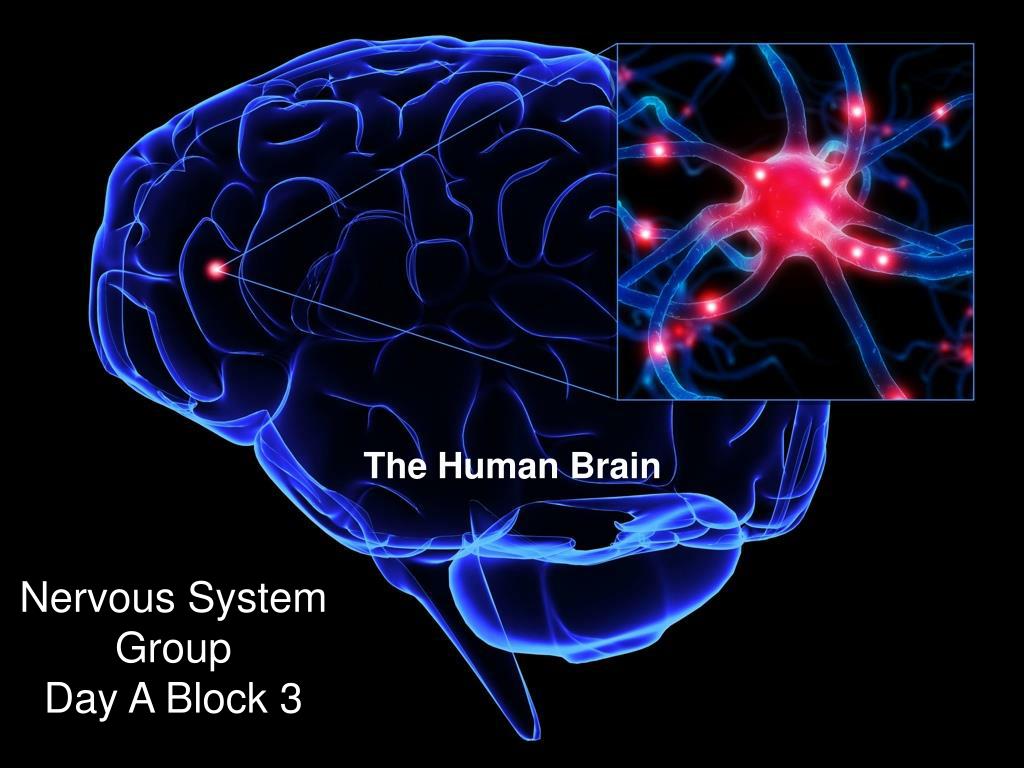
The Human Brain. Nervous System Group Day A Block 3. Brain Anatomy. Weighs around 3 pounds or 1.4 Kilograms. Divided into four main areas: Brain Stem, Cerebellum, Diencephalon, and Cerebrum. 1. Brain Stem. Located at the base of the Brain Regulates reflexes and basic involuntary actions.
The Human Brain - slide 1
01 / 20The Human Brain
1 / 17

Télécharger la présentation

The Human Brain
Une image / un lien ci-dessous est fourni (tel quel) pour télécharger la présentation

Politique de téléchargement : le contenu du site vous est fourni TEL QUEL pour votre information et votre usage personnel ; il ne peut être vendu, concédé sous licence ni partagé sur d’autres sites sans l’accord de son auteur.Le contenu vous est fourni TEL QUEL, pour votre information et votre usage personnel uniquement. Téléchargez la présentation en cliquant sur ce lien. Lors du téléchargement, si vous ne parvenez pas à télécharger une présentation, l’éditeur a peut-être supprimé le fichier de son serveur.Pendant le téléchargement, si vous ne parvenez pas à obtenir une présentation, le fichier a peut-être été supprimé par l’éditeur.

F I N

Plus de contenu associé

Transcription de la présentation
  1. The Human Brain Nervous System Group Day A Block 3

  2. Brain Anatomy • Weighs around 3 pounds or 1.4 Kilograms. • Divided into four main areas: Brain Stem, Cerebellum, Diencephalon, and Cerebrum.

  3. 1. Brain Stem • Located at the base of the Brain • Regulates reflexes and basic involuntary actions. • Regulates heart rate, breathing, sleeping, and blood pressure.

  4. II. Cerebellum • The second largest part of the brain. • Coordinates muscle movement and controls balance. • Receives information from spinal cord and other parts of the brain.

  5. III. Diencephalon • Composed of Thalamus, Hypothalamus, Epithalamus, and Subthalamus. • Inner part of the brain. • Relay system for sensory input. • Interactive site for central nervous and endocrine system.

  6. IV. Cerebrum • Largest part of the brain. • AKA Cerebral Cortex. • Processing center for thought, language, memory, sensory information, and movement. • The Cerebrum is divided into four different lobes that perform specific tasks.

  7. I. Frontal Lobe • Two frontal lobes. • Directly behind forehead. • Responsible for complex mental processes including: speech, thought, learning, emotion, and movement. • Only some aspects of memory take place here.

  8. II. Occipital Lobe • Sits at the back of the brain behind the occipital bone. • Main job is to process visual images.

  9. III. Parietal Lobe • Located on the sides of the upper part of the brain. • Main Function is to interpret bodily sensations including: touch, temperature, and pain.

  10. IV. Temporal Lobe • Located on sides of lower part of the brain. • Main function is to process sounds. • Has a memory function as well. • Sectors here assist with vision.

  11. Interior Anatomy

  12. Pons, Pituitary Gland, Pineal Gland • Pons-Inside brain stem. Relay station for sensory information and movement. Regulates sleep. • Pituitary-Part of endocrine system. • Pineal Gland-Connected to our optic nerves and regulates sleep by secreting melatonin (hormone that causes sleepiness).

  13. Fornix, Corpus Callosum, Midbrain • Fornix-Wishbone shaped. Bundle of nerve fibers that connects certain parts of brain (limbic system). • Corpus Callosum-Long band of nerve fibers between cerebral hemispheres. Communication between left and right sides of our brain. • Midbrain-Located on top of brain stem. Delivers processed information regarding sight, hearing, and body movement.

  14. Medulla Oblongata • Lower portion of brain stem. • Controls certain involuntary functions including: breathing, heartbeat, and blood pressure.

  15. Main Source: • http://science.nationalgeographic.com/science/health-and-human-body/human-body/brain-article/