Understanding Correlation Coefficients and Regression Model Assumptions
20 likes | 134 Vues
This document explores the fundamental concepts of correlation coefficients and regression model assumptions in statistics. It covers what the sum of all residuals equals, interpretations of negative and positive correlations, and the principle of parsimony, emphasizing the preference for simpler models in forecasting. Additionally, it outlines critical assumptions of regression models, including constant variance of the error term, independence of error terms, and the mean of error terms equaling zero. Aimed at enhancing statistical analysis understanding.


Understanding Correlation Coefficients and Regression Model Assumptions
E N D
Presentation Transcript
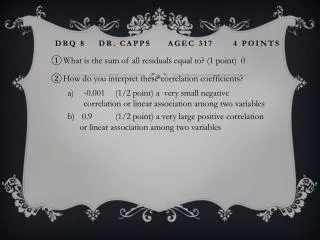
DRQ 8 Dr. Capps AGEC 317 4 points • What is the sum of all residuals equal to? (1 point) 0 • How do you interpret these correlation coefficients? • -0.001 (1/2 point) a very small negative correlation or linear association among two variables • 0.9 (1/2 point) a very large positive correlation or linear association among two variables
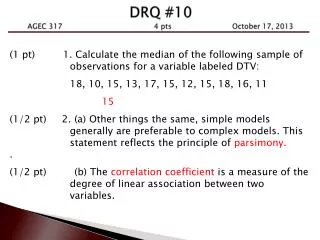
DRQ 8 Dr. Capps AGEC 317 4 points • __Principle of Parsimony(definition)___ simple models are generally preferred to complex models, especially in forecasting (1 point) • What are two of the four assumptions of a regression model? • Constant variance of the error term • No correlation of the error term at observations i and j • No correlation of the error term with any explanatory variable • The mean of the error term is equal to 0