Engaging EYFS Addition, Subtraction, Multiplication, and Division Activities for Young Learners
Explore an interactive and practical approach to teaching addition, subtraction, multiplication, and division to young learners in the EYFS (Early Years Foundation Stage). This resource features fun counting activities, engaging number lines, and video clips that demonstrate various methods from practical counting to compact techniques. Children will learn to count forwards and backwards, solve problems with visuals, and develop a strong mathematical foundation through play and guided activities, making math both enjoyable and educational.

Engaging EYFS Addition, Subtraction, Multiplication, and Division Activities for Young Learners
E N D
Presentation Transcript
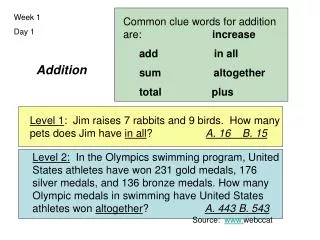
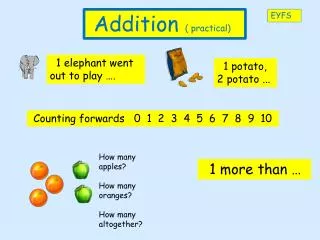
EYFS Addition ( practical) 1 elephant went out to play …. 1 potato, 2 potato ... Counting forwards 0 1 2 3 4 5 6 7 8 9 10 How many apples? How many oranges? How many altogether? 1 more than …
Stage 1 Addition ( practical) makes 5 Click here for video clip 1a and 2 3 Click here for video clip 1b Make 6 Click here for video clip 1c Click here for video clip 1d 6 and 0 4 and 2 3 and 3 5 and 1
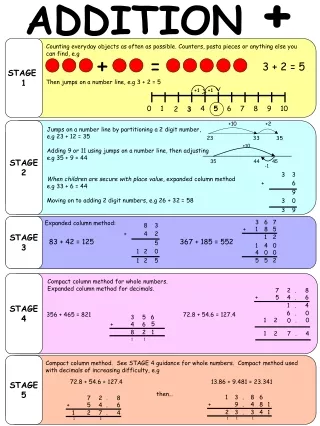
Stage 2 Addition ( printed numberlines) 2 + 6 = 8 (same as 6 + 2) 4 + 3 = 7 Click here for video clip 2 0 0 4 4 8 8 7 7 5 5 1 1 2 2 6 6 3 3
Addition (blank numberlines) Stage 3 38 + 23 = 61 At first… Click here for video clip 3a +10 +10 +1 +1 +1 61 38 48 59 60 58 38 + 23 = 61 Then… Click here for video clip 3b +20 +3 38 61 58
Stage 4 Addition (partitioning) 45 + 23 = 345 + 132 = 40 + 5 300 + 40 + 5 20 + 3100 + 30 + 2 60 + 8400 + 70 + 7 68 477 Click here for video clip 4a Click here for video clip 4c Click here for video clip 4b
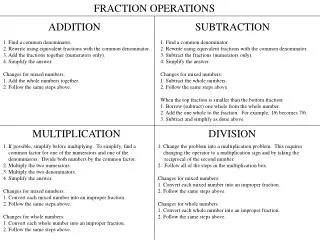
Stage 5 Addition (compact method) 366 + 458 = 147 + 73 = 58 + 23 = 58 + 23 81 1 366 + 458 824 1 1 147 + 73 220 1 1 Click here for video clip 5b Click here for video clip 5c Click here for video clip 5a
EYFS Subtraction (practical) 5 little speckled frogs… 10 green bottles... 5 little men in a flying saucer… 10 fat sausages sizzling in pan… Counting backwards 10 9 8 7 6 5 4 3 2 1 0 1 less than ……
Subtraction (practical) Stage 1 3 counters take away 2 leaves 1. Sam has 7 sweets. He eats 3 of them. How many does he have left? 7 - 3 = 4 THE LARGER NUMBER HAS TO GO FIRST Click here for video clip 1c Click here for video clip 1b Click here for video clip 1a
Subtraction (printed numberlines) Stage 2 Click here for video clip 2a COUNT BACKWARDS 10 – 6 = 4 8 8 0 0 4 4 5 5 7 7 1 1 2 2 6 6 3 3 9 9 10 10 COUNT ON TO FIND THE DIFFERENCE Click here for video clip 2b 5 + = 9 4 9 - 5 = 4
Subtraction (blank numberline) Stage 3 For taking away small amounts COUNT BACKWARDS. Click here for video clip 3a 67 – 11 = 56 -10 -1 For taking away large amounts COUNT ON from small number to large. 56 57 67 65 - 57 = 8 3+5=8 +5 +3 60 65 57 2+10+9 = 21 69 – 48 = 21 +10 +2 +9 Click here for video clip 3b 48 50 60 69
Stage 4 Subtraction (partitioning) 74 – 27 = 47 758 - 367 = 391 700 + 50 +8 -300 + 60 +7 300 + 90 + 1 70 + 4 -20 + 7 40 + 7 14 60 150 600 Click here for video clip 4
Stage 5 Subtraction (compact method) 7 8 4 30 4 20 3 9 - 5 7 - 1 3 8 - 1 8 4 5 7 2 71 6 6 1 9 4 1 9 9 7 2 1 1 1 Click here for video clip 5b Click here for video clip 5a
Multiplication (practical) EYFS Counting in 2s 8 10 6 2 4 Counting in 10s 40 20 30 10
Stage 1 Multiplication 4 + 4 = 8 2 lots of 4 are 8 2 x 4 = 8 Click here for video clip 1 2 + 2 + 2 + 2 = 8 4 lots of 2 are 8 4 x 2 = 8 0 4 8 2 6
Stage 2 Multiplication 6 x 8 = 48 +8 +8 +8 +8 +8 +8 0 8 16 24 32 40 48 4 x 8 = 32 Click here for video clip 2 8 x 4 = 32
Multiplication (partitioning) Stage 3 4 x 13 = 52 10 3 40 + 12 = 52 4 Click here for video clip 3a Click here for video clip 3b
Multiplication (grid method) Stage 4 300 120 30 + 12 462 14 x 33 = 462 Click here for video clip 4a 3 30 10 4 40 6 300 9 x 346 = 3114 2700 360 + 54 3 1 14 9 Click here for video clip 4b 4 0.9 12 + 2.7 14.7 3 x 4.9 = 14. 7 3
Multiplication (compact method) Stage 5 274 X 92 548 24660 25208 326 X 71 326 22820 23146 Click here for video clip 5 1 4 1 6 3 1 1 1
Division (practical) EYFS Sharing 6 cakes between 2 people. One for you.. One for me..
Division (practical) Stage 1 Sharing 12 cakes between 3 people is 4 each 12 ÷3 = 4 Click here for video clip 1a Grouping 12 cakes into groups of 3 gives 4 sets. 12 ÷3 = 4 Click here for video clip 1b
Division (printed/blank numberlines) Stage 2 Click here for video clip 2a 10 ÷ 2 = 5 8 0 4 5 7 1 6 3 9 10 2 20 ÷5 = 4 Click here for video clip 2b +5 +5 +5 +5 20 0 5 10 15
Division (blank numberline chunking 2s 5s 10s) Stage 3 45 ÷ 5 = 9 9 x 5 2x5 2x5 2x5 2x5 1x5 45 20 30 40 0 10 Click here for video clip 3 15 x 5 75 ÷ 5 = 15 10 x 5 2 x 5 2 x 5 1 x 5 60 50 75 70 0
Division (chunking on blank numberline) Stage 4 10 +1 +1 +1 =13 104 ÷ 8 = 13 8 8 Click here for video clip 4a TIP X 10 FIRST IF YOU CAN 106 ÷ 7 = 15 r1 10+2+2+1= 15 10 x 7 10 x 8 1x8 1x8 1x8 2x7 2x7 1x7 80 70 r1 8 7 14 14 0 0 70 80 88 84 96 98 105 104 Click here for video clip 4b
Division (chunking) Stage 5 325 ÷ 12 = 27 r1 325 (20 x 12) 240 - 85 ( 5 x 12) 60- 25 (2 x 12) 24 - 27 r1 What do I know already? 10 x 12 = 120 20 x 12 = 240 5 x 12 = 60 2 x 12 = 24 Choose a large ‘best fit’ chunk to start off with. Click here for video clip 5