Plate Tectonic Notes
This document outlines key concepts in plate tectonics, specifically focusing on stress and deformation in geological materials. It explains how stress, defined as force per unit area, affects rocks, influenced by composition, temperature, and pressure. Different types of stress, including compression and tension, are described, alongside the processes of folding and faulting. It sheds light on the formation of various mountain types, including folded, fault-block, and volcanic mountains, and provides visual resources for deeper understanding.

Plate Tectonic Notes
E N D
Presentation Transcript
Plate Tectonic Notes Spring 2006, Pflugerville ISD
Stress is the amount of force per unit area put on a given object. Deformation is the rock changing due to stress. *Three things determine how much stress a rock can handle: composition, temperature and amount of pressure. Spring 2006, Pflugerville ISD
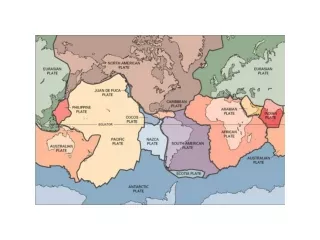
Types of Stress: Compression is when two plates collide. (squeezing) Tension is when two plates pulling away from each other. (stretching) Cite: http://www.solaster-mb.org/mb/images/dyrynda-tectonics-1-wl.GIF Spring 2006, Pflugerville ISD
Folding is the bending of rock Anticline are arch-shaped folds. Syncline are trough-shaped folds. Monocline are rocks that have vertical stress and the ends are still horizontal. Anticline Cite:http://www.salem.k12.va.us/staff/flester/lester/foldsandfaults/anticline.gif Syncline Spring 2006, Pflugerville ISD Cite: http://www.salem.k12.va.us/staff/flester/lester/syncline.gif
Cite: http://www.nps.gov/brca/Geodetect/Photo%20book/LF%20pix/images/Monocline%20Cross%20Section%20_TIF.jpg Monocline Spring 2006, Pflugerville ISD
Cite: http://www.geosci.unc.edu/faculty/glazner/Images/Structure/Monocline.jpg Monocline in the Mojave Desert, California Spring 2006, Pflugerville ISD
Cite: http://www-class.unl.edu/geol101i/images/structure%20images/anticline%20from%20Wind%20Rivers.jpg Anticline in Wind Rivers, Wyoming Spring 2006, Pflugerville ISD
Cite: http://users.ipfw.edu/isiorho/Syncline.JPG Spring 2006, Pflugerville ISD
Faulting is breaking of rocks Footwall is one side of the rock. Hanging wall is the other side of the rock. A normal fault is when the rocks pull away from each other, the hanging wall moves down. A reverse fault is when rocks are pushed together, the hanging wall is pushed up. Spring 2006, Pflugerville ISD
Normal Fault Cite: http://www.calstatela.edu/faculty/acolvil/struct/normal_animation.gif Spring 2006, Pflugerville ISD
Reverse Fault Cite: http://www.earthsci.org/struct/fault/reverse.gif Spring 2006, Pflugerville ISD
Strike-slip Fault is when the rock breaks and move horizontally. Spring 2006, Pflugerville ISD
Strike Slip Fault Cite: http://darkwing.uoregon.edu/~nfay/home/right_lateral_fault.gif Spring 2006, Pflugerville ISD
Mountain Building Notes Spring 2006, Pflugerville ISD
Most mountain ranges form where plates collide- convergent boundary. Uplift is the process by which regions of the crust are raised to a higher elevation. Spring 2006, Pflugerville ISD
Cite: http://www.calstatela.edu/faculty/acolvil/plates/subduction.jpg Spring 2006, Pflugerville ISD
Folded Mountains are formed when rock layers are squeezed together. Appalachians Fault - Block Mountains are formed when faulting causes large blocks of the crust to drop down. Tetons Volcanic Mountains are formed when molten rocks erupts onto the Earth’s surface. Divergent boundary. Spring 2006, Pflugerville ISD
Fault Block Mountains Citehttp://cse.cosm.sc.edu/erth_sci/Metamorf/ue3588.jpg: Spring 2006, Pflugerville ISD
Folded Mountains in Canada Cite: http://cse.cosm.sc.edu/erth_sci/Metamorf/ue1868.jpg Spring 2006, Pflugerville ISD
Volcanic Mountain Cithttp://cse.cosm.sc.edu/erth_sci/Metamorf/ss5_3.jpge: Spring 2006, Pflugerville ISD