
Physics Concepts
E N D
Presentation Transcript
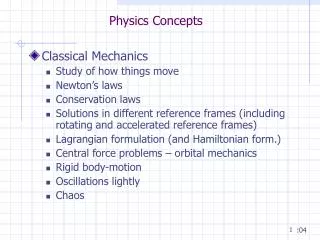
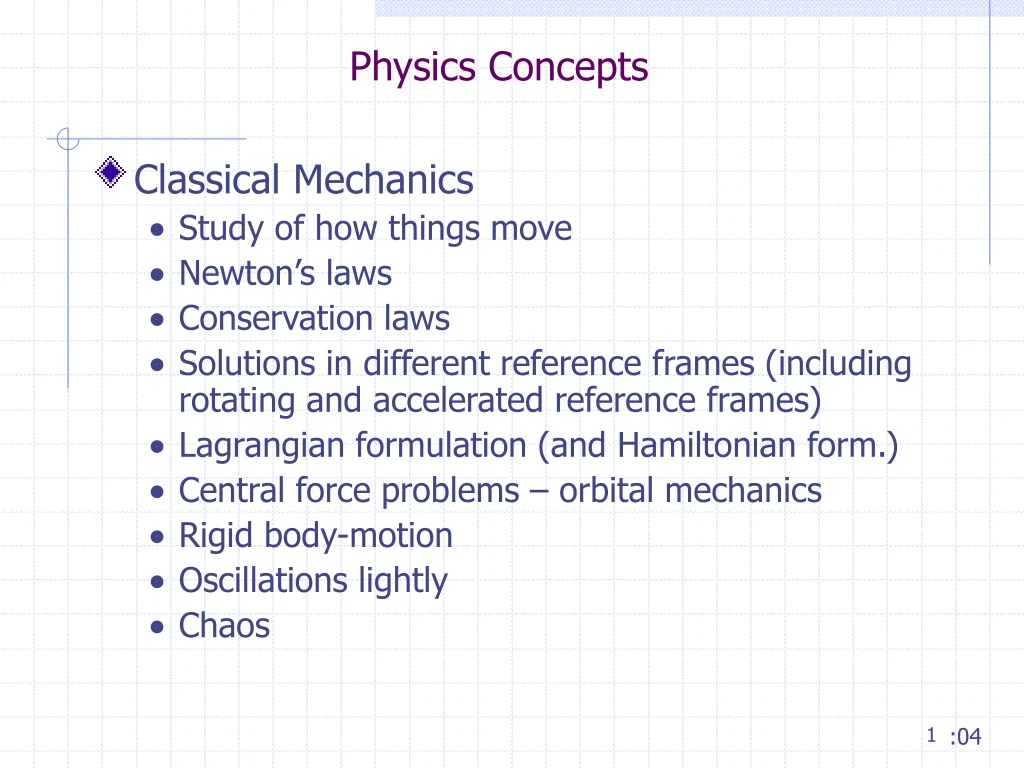
Physics Concepts • Classical Mechanics • Study of how things move • Newton’s laws • Conservation laws • Solutions in different reference frames (including rotating and accelerated reference frames) • Lagrangian formulation (and Hamiltonian form.) • Central force problems – orbital mechanics • Rigid body-motion • Oscillations lightly • Chaos :04
Mathematical Methods • Vector Calculus • Differential equations of vector quantities • Partial differential equations • More tricks w/ cross product and dot product • Stokes Theorem • “Div, grad, curl and all that” • Matrices • Coordinate change / rotations • Diagonalization / eigenvalues / principal axes • Lagrangian formulation • Calculus of variations • “Functionals” and operators • Lagrange multipliers for constraints • General Mathematical competence :06
Correlating Classical and Quantum Mechanics • Correspondence Principle • In the limit of large quantum numbers, quantum mechanics becomes classical mechanics. • First formulated by Niels Bohr, one of the leading quantum theoreticians • We will illustrate with • Particle in a box • Simple harmonic oscillator • Equivalence principle is useful • Prevents us from getting lost in “quantum chaos”. • Allows us to continue to use our classical intuition as make small systems larger. • Rule of thumb. System size>10 nm, use classical mechanics. :02
1-D free particle Classical Lagrangian and Hamiltonian for free 1-D particle Schroedinger’s equation for free particle :02
Hydrogen Atom Classical Lagrangian and Hamiltonian Schroedinger’s equation for hydrogen :02
Hydrogen Atom Schroedinger’s equation for hydrogen :02
Particle in a box N=1, no match between quantum and classical probability N=51, Averaged quantum probability approaches classical constant probability. :02
Expectation values Bra-ket notation and Matrix formulation of QM All wave functions may be written as linear combination of eigenfunctions. Thus effect of operator can be replaced by a matrix showing effect of operator on each eigenfunction. All QM operators (p, L, H) have real eigenvalues – They are “Hermitian” operators :02
Expectation values Bra-ket notation and Matrix formulation of QM All wave functions may be written as linear combination of eigenfunctions. Thus effect of operator can be replaced by a matrix showing effect of operator on each eigenfunction. All QM operators (p, L, H) have real eigenvalues – They are “Hermitian” operators :02
Spin Matrix :02
Wind up Classical mechanics is valid for In other words … almost all of human experience and endeavor. Use it well! :02