Understanding Parallelograms: Properties and Applications in Coordinate Geometry
Dive into the essential properties of parallelograms and their applications in coordinate geometry. Learn how a parallelogram is defined as a quadrilateral with both pairs of opposite sides parallel and congruent. Explore key characteristics such as the congruence of opposite angles, the supplementary nature of consecutive angles, and the bisecting properties of diagonals. This guide provides insights into finding angle measures, solving for sides, and using coordinates to understand the intersection of diagonals. Ideal for geometry enthusiasts and students alike.

Understanding Parallelograms: Properties and Applications in Coordinate Geometry
E N D
Presentation Transcript
6.2 Parallelograms Check.3.2 , Connect coordinate geometry to geometric figures in the plane (e.g. midpoints, distance formula, slope, and polygons). Check.4.10 , Identify and apply properties and relationships of special figures (e.g., isosceles and equilateral triangles, family of quadrilaterals, polygons, and solids). Spi.3.2 Use coordinate geometry to prove characteristics of polygonal figures.
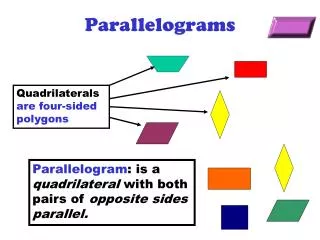
Parallelograms A parallelogram is a quadrilateral with both pairs of opposite sides parallel. A B D C Properties of Parallelogram Opposite Sides of a parallelogram are congruent Opposite Angles of a parallelogram are congruent Consecutive Angles of a parallelogram are supplementary. mA+ mB = 180, mB+ mC = 180 mC+ mD = 180, mD+ mA = 180 If a parallelogram has 1 right angle, it has 4 right angles
Parallelograms A parallelogram is a quadrilateral with both pairs of opposite sides parallel. B A C D Properties of Parallelogram Diagonals of a parallelogram bisect each other Each Diagonal of a parallelogram separates the parallelogram in to two congruent Triangles
Applying Properties • Quadrilateral LMNP is a parallelogram. • Find mPLM, mLMN, and d. • mPNM = 66 + 42 = 108 by angle addition • mPNM = mPLM Opposite angles of parallelogram are • mPLM = 108 Substitution • mPL M + mLMN = 180, Consecutive Angles of parallelograms are supplementary. • 108 +mLMN = 180, substitution • mLMN = 72 • LM PN, opposite sides of Parallelogram are congruent • 2d = 22 • D = 11
Solve • 3y = 18 • y = 6 URT = 40 UTS = 18+40 = 58 UTS = URS = 58 UTS + RST = 180 58 + RST = 180 RST = 122
Diagonals of Parallelogram • What are the coordinates of the intersection of the diagonals of a parallelogram ABCD with vertices A(2, 5), B(6,6), C(4,0) and D(0, -1)? • Diagonals of parallelogram bisect each other.
Summary • Parallelograms have • Opposite sides are parallel and congruent • Opposite angles are congruent • Consecutive angles are supplementary • Diagonals bisect each other • Practice Assignment • Block Page 404, 10 - 22 Even