Typical Welding Problems That People Encounter
Safety is also one of the most important things to look on the welding process. Welding inspections are a must all throughout the welding process. During the welding process, avoid working alone in hazardous areas. Employ a suitable hazard-reduction device. When welding, avoid leaning against the material or structure. While working, use personal protective equipment such as welding gloves and rubber-insulated shoes.<br><br>Flashback arrestor testing must also be done once every six months or twelve months at most. This process can help in the safety and identification of any hazards that the weldin


Typical Welding Problems That People Encounter
E N D
Presentation Transcript
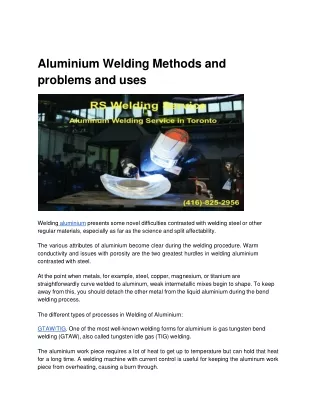
Typical Welding Problems That People Encounter Welding is the process of welding metals together. With the technologies available today, welding joins metals or other materials at the molecular level. Welding technology is constantly evolving, and with so many armed forces relying on it to manufacture defence items, there are welding methods that we have yet to learn about. The welding sector is currently thriving nowadays. While we have the best and most up-to-date welding equipment and supplies, we sometimes need to pay attention to some essential tasks while working on the job regardless of how long we are in the industry. A weld has four components, according to what we know about current welding. The metals themselves, a heat source, filler material, and some type of air shield are the four main components. The metal is heated to its melting point while being shielded from the air, and then a filler metal is added to the area that has to be bonded, eventually will be generating a single piece of metal.
Safety is also one of the most important things to look on the welding process. Welding inspections are a must all throughout the welding process. During the welding process, avoid working alone in hazardous areas. Employ a suitable hazard-reduction device. When welding, avoid leaning against the material or structure. While working, use personal protective equipment such as welding gloves and rubber-insulated shoes. Flashback arrestor testing must also be done once every six months or twelve months at most. This process can help in the safety and identification of any hazards that the welding process might bring during the procedure. Welding issues are normal and fixable. Here are some of the welding problems that people encounter and tips on how to work them out: 1. Lack of Fusion and Incomplete Penetration Incomplete penetration happens when both sides of the joint are not fused together, whereas lack of fusion occurs when the weld fails to fuse or penetrate one side of the joint in the root. You may avoid these problems by utilising a bigger root gap and electrodes with a diameter roughly equal to the width of the root gap. 2. Disfigurement When the welded metals are heated and cooled, distortion occurs. You may suffer distortion if your welding sequence is not appropriate for the planned weld, there are too many thin beads, or your plate fit-ups are insufficient. Avoiding distortion by modifying the weld sequence, and joint position, or performing fewer passes can also help to prevent deformation. 3. Weakened or Undermined Weld Undercuts can be an issue if your arc voltage is too high, your arc is too long, your travel speed is too fast, or you're using the wrong electrode.
To avoid the dreaded undercut, monitor your speed, double-check your electrode, and double-check your present settings. Employing a larger electrode than is required can result in the creation of too much-molten metal. 4. Permeability of the Weld Another prevalent problem during a weld is porosity. It results from the absorption and subsequent release of gases such as nitrogen, oxygen, and hydrogen. These gases become trapped in the weld metal, causing holes in the weld. Porosity can also be caused by insufficient gas shielding, small air gaps, and the presence of moisture, corrosion, grease, or paint on your plate edges. WELDING TIP: Use dry, well-kept welding consumables and inspect your welding torch for leaks to avoid weld porosity. 5. Spatter Spatter is frequent in gas metal arc welding... yet it is undesirable! Spatter is droplets of molten material that form near the welding arc when currents are too high, the polarity is wrong, or there is insufficient gas shielding. Reduce the welding current and arc length to avoid spatter. Check the polarity, shielding gas type, and flow rate of your consumables, and make sure your gas nozzle is clean. WELDING TIP: Employ a welding blanket to protect your work area from spatter and anti-spatter spray on your welding tools to prevent spatter stick. 6. Slag Inclusion Spatter is common in gas metal arc welding... yet it is unwelcome! Spatter is molten material droplets that form near the welding arc when the current is too high, the polarity is incorrect, or there is insufficient gas shielding. To avoid spatter, reduce the welding current and arc length. Inspect the polarity, shielding gas type, and flow rate of your consumables, as well as the cleanliness of your gas nozzle.
WELDING TIP: Use a welding blanket to shield your work area from spatter and anti-spatter spray on your welding instruments to keep spatter from sticking to your tools. 7. Rupture on Weld Cracks, aside from being unsightly, can cause a plethora of problems and hazards during the whole welding procedure. They also demand some repair labour, which can be so much consuming of time, aggravating, and costly. It is as simple as grinding, cleaning, filling, and or deburring the edges of your plates and warming both sides of the junction to avoid cracks on the weld itself. Check that the temperature you are using is adequate for the process before starting your weld. There are many issues that you might encounter. But having these things listed made your life easier for sure. Do not compromise your safety when you are working. Weld and safety are two things that must never leave each other’s side. Seek professional advice today, and visit one of the trusted companies to keep your welding safe.