HUMAN EYE
The human eye operates similarly to a camera, with its components performing specific roles. The cornea acts as the lens cover, bending light rays through the pupil to help focus images. The iris and pupil function like a camera's aperture, controlling light entry. When vision defects occur, such as nearsightedness, farsightedness, and astigmatism, corrective lenses can adjust light rays to ensure clarity on the retina. This overview explores how the eye's anatomy contributes to vision and addresses common visual impairments.

HUMAN EYE
E N D
Presentation Transcript
HUMAN EYE Done By:- - Alia Ali Alshamsi - MahraMatarAlnuaimi
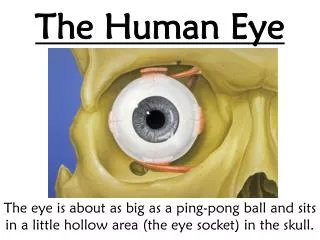
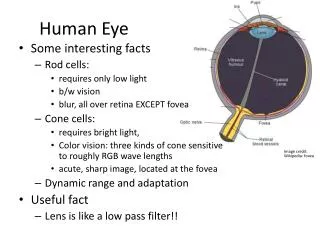
How Does The Human Eye Work? The individual components of the eye work in a manner similar to a camera. So think of the eye as a camera with the cornea, behaving much like a lens cover. s main focusing element, the cornea takes widely diverging rays of light and bends them through the pupil, the dark, round opening in the center of the colored iris. The iris and pupil act like the aperture of a camera. Next in line is the lens which acts like the lens in a camera, helping to focus light to the back of the eye.
NearsightednessObjects that are further away look fuzzy because the eye brings them in to focus at a point in front of the retina.To correct for this, a diverging lens is placed in front of the eye, diverging the light rays just enough so that when the rays are converged by the eye they converge on the retina, creating a focused image.
FarsightednessClose objects are brought to a focus behind the retina, which is why they look fuzzy. To correct for this, a converging lens is placed in front of the eye, allowing images to be brought into sharp focus at the retina.
AstigmatismThe front surface of the eye (cornea) of a person with astigmatism is not curved properly - the curve is irregular - usually one half is flatter than the other - sometimes one area is steeper than it should be.Corrected by an asymmetric lens to compensate for the asymmetry of the eye’s lens.