Understanding the Runge-Kutta 4th Order Method in Electrical Engineering Education
This resource provides an in-depth guide on the Runge-Kutta 4th Order Method, essential for solving ordinary differential equations in electrical engineering applications. Authored by Autar Kaw and Charlie Barker, it covers the formulation of differential equations, example problems such as sizing capacitors in rectifier-based power supplies, and the impact of step sizes on solution accuracy. Additionally, the resource compares the Runge-Kutta methods with other numerical methods, offering valuable insights for STEM undergraduates. For further learning, a variety of resources are linked.

Understanding the Runge-Kutta 4th Order Method in Electrical Engineering Education
E N D
Presentation Transcript
Runge 4th Order Method Electrical Engineering Majors Authors: Autar Kaw, Charlie Barker http://numericalmethods.eng.usf.edu Transforming Numerical Methods Education for STEM Undergraduates http://numericalmethods.eng.usf.edu
Runge-Kutta 4th Order Methodhttp://numericalmethods.eng.usf.edu
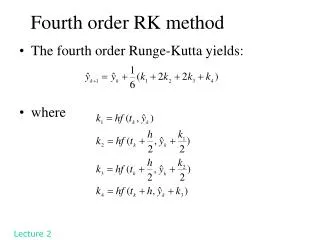
Runge-Kutta 4th Order Method For Runge Kutta 4th order method is given by where http://numericalmethods.eng.usf.edu
How to write Ordinary Differential Equation How does one write a first order differential equation in the form of Example is rewritten as In this case http://numericalmethods.eng.usf.edu
Example A rectifier-based power supply requires a capacitor to temporarily store power when the rectified waveform from the AC source drops below the target voltage. To properly size this capacitor a first-order ordinary differential equation must be solved. For a particular power supply, with a capacitor of 150 μF, the ordinary differential equation to be solved is Find voltage across the capacitor at t= 0.00004s. Use step size h=0.00002 http://numericalmethods.eng.usf.edu
Solution Step 1: http://numericalmethods.eng.usf.edu
Solution Cont is the approximate voltage at http://numericalmethods.eng.usf.edu
Solution Cont Step 2: http://numericalmethods.eng.usf.edu
Solution Cont is the approximate voltage at http://numericalmethods.eng.usf.edu
Solution Cont The exact solution to the differential equation at t=0.00004 seconds is http://numericalmethods.eng.usf.edu
Comparison with exact results Figure 1. Comparison of Runge-Kutta 4th order method with exact solution http://numericalmethods.eng.usf.edu
Effect of step size Table 1 Value of voltage at time, t=0.00004s for different step sizes (exact) http://numericalmethods.eng.usf.edu
Effects of step size on Runge-Kutta 4th Order Method Figure 2. Effect of step size in Runge-Kutta 4th order method http://numericalmethods.eng.usf.edu
Comparison of Euler and Runge-Kutta Methods Figure 3. Comparison of Runge-Kutta methods of 1st, 2nd, and 4th order. http://numericalmethods.eng.usf.edu
Additional Resources For all resources on this topic such as digital audiovisual lectures, primers, textbook chapters, multiple-choice tests, worksheets in MATLAB, MATHEMATICA, MathCad and MAPLE, blogs, related physical problems, please visit http://numericalmethods.eng.usf.edu/topics/runge_kutta_4th_method.html
THE END http://numericalmethods.eng.usf.edu