Diffraction Image Library
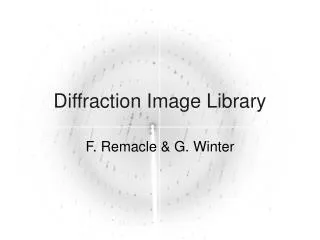
The Diffraction Image Library, developed by Remacle and Winter, provides a C++ framework to access diffraction image data from various formats in a standardized way. Initially aimed at DNA and X-ray crystallography (XIA), it is now part of the CCP4 library. It supports image reading from multiple detectors such as ADSC, Rigaku, and Bruker. Users can retrieve standard information like beam center, wavelength, exposure time, and perform calculations such as histogram and radial profiles. Additionally, it allows saving data as JPEG or PPM files and integrates with Tcl and Python.

Diffraction Image Library
E N D
Presentation Transcript
Diffraction Image Library F. Remacle & G. Winter
What is it? • A C++ library to access data of various formats of diffraction images in a standard way. • Originally developed for DNA and XIA, now being developed further as part of the CCP4 library.
What can be done with it? • Reading images from the following detectors: • ADSC (all) • Rigaku: R-AXIS IV, SATURN • Mar: MAR300, MAR345, MARCCD • CBF (in development) • Bruker
What can be done with it? • Access to “standard” information • Beam centre coordinates • Distance to detector • Wavelength • 2 Theta value • Exposure time • Image size • Collection time • Pixel size • Oscillation range • Image data (pixel values)
What can be done with it? • Different calculations (histogram, asymmetry, corner, radial profile, gain) • Writing image data as jpeg or ppm. • Peak finding and other peak operations with the PeakList object. • Available as Tcl and Python modules!
Who is using it? • Me, for writing a Tcl new version of ipdisp. Now called idiffdisp. • xia2 currently wraps compiled programs built on the library, but will use the python module directly in the future.