Download
1 / 41
410 likes | 513 Vues
This work by James Dunlop provides insights into galaxy formation and evolution, focusing on the sub-mm view. It outlines key aspects including surveys and number counts from SHADES data, identifying and measuring redshifts for various sources, analyzing sizes and morphologies of galaxies, and exploring the nature of sub-mm galaxies. Findings reveal important connections between star formation rates and host galaxy masses, shedding light on the dynamics of galaxy development in the early universe. Future prospects for research, including potential new instruments, are also discussed.

E N D
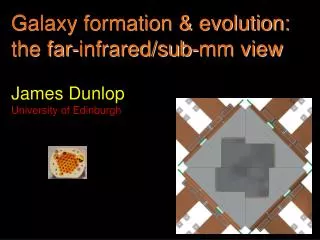
Galaxy formation & evolution: the sub-mm view James Dunlop
Outline 0. Why? 1. Surveys and number counts 2. Identifications and redshifts 3. Sizes, morphologies and masses 4. The nature of sub-mm galaxies 5. Future prospects
SHADES DATA 3 years observing with an increasingly ill SCUBA • SCUBA 850-micron map of ~1/4 sq. degrees • 850 rms ~2 mJy • Two fields – Lockman Hole & SXDF • Major multi-frequency follow-up • VLA, GMRT, UKIRT, Spitzer, Subaru, Keck, Gemini, VLT, AAT, • XMM, Chandra, SMA, AzTEC
SHADES SCUBA 850-micron maps 2 fields – Lockman Hole & SXDF/UDS 4 independent reductions combined to produce one SHADES catalogue 120 sources with unbiased (deboosted) flux densities
Number counts Coppin et al. 2006 Estimated background of sources >2mJy is ~9700 mJy/deg2 >20-30% of FIRB resolved
New SHADES AzTEC 1.1mm maps (SNR maps shown here produced by Jason Austerman)
850-micron contours on 1.1mm greyscale Joint SCUBA+AzTEC source extraction now being explored
Radio and mid-infrared Ivison et al., (2007) 25 x 25 arcsec stamps VLA radio contourson R-band Subaru image, and Spitzer 24-micron image 85-90% of the 120 sources identified via VLA and/or Spitzer
Sometimes identification can be trickye.g. SMA follow-up of SXDF850.6Iono et al. (2008) SMA VLA 1.4 GHz Optical - Subaru
Finally …….unambiguous K-band ID SMA on opticalSMA on K-band • Demonstrates • power of sub-mm interferometry • importance of near-IR data identification & study of host galaxy
SMA – a glimpse of ~1 arcsec sub-mm astronomy Younger et al. (2007)
Redshifts • 4 different forms of redshift information: • Spectroscopic – Chapman et al., Stevens et al. • Far-infrared to radio – Carilli & Yun, Aretxaga et al. • Optical – near-infrared – Dye et al., Clements et al. • Spitzer – Pope et al. In SHADES only ~12 (ie 10%) of sources currently have an unambiguous spectroscopic z
GN20 – Iono et al. 2006 Younger et al. 2008 COSMOS AzTEC 1 – Younger et al. 2007 GOODS 850.5 – Wang et al. 2008 SFR > 2000 Msun yr -1 SFR > 1000 Msun yr -1
Evidence of down-sizing: Clear that the comoving number density of > 5 mJy sub-mm sources peaks in redshift range 2 < z < 3 Brightest (>12 mJy) sources lie at 3 < z < 4 < 5mJy sources span much wider z range
Number densities at 2 < z < 3 Mstar >1011 Msun : 1 x 10⁻⁴ Mpc-3 SFR > 500 Msun yr -1 : 2 x 10⁻⁵ Mpc-3 SFR > 1000 Msun yr -1 : 3 x 10⁻⁶ Mpc-3 SFR > 2000 Msun yr -1 : 1 x 10⁻⁶ Mpc-3
3. Sizes, morphologies, masses Some new results from Targett, Dunlop, et al. (2008)
Deep, high-resolution (0.4 arcsec) K-band imaging of 13 radio galaxies and 15 8-mJy sub-mm galaxies at z ~ 2 Radio galaxies = known elliptical progenitors Sub-mm galaxies = possible elliptical progenitors
Results from galaxy model fitting Sub-mm galaxies Radio galaxies Sizes Kormendy relation at z = 2
Morphologies Sub-mm galaxies are mainly discs Radio galaxies are r1/4 spheroids
Image Stack ~50 hr UKIRT image of z = 2 radio galaxy ~20 hr Gemini image of z = 2 submm galaxy
Masses Await decent clustering measurements to characterize typical CDM halo masses of submm galaxies CO dynamical masses suggest ~1011 Msun within r ~ 2 kpc (Tacconi et al. 2006) We find typical stellar masses ~ 3 - 5 x 10¹¹ Msun and typical r0.5 = 2-3 kpc (See also Dye et al. 2008, and Wang et al 2008)
4. The nature of sub-mm galaxies Sometimes claimed that sub-mm galaxies are bizarre objects in a very unusual phase/mode of star formation But….
You’d expect such a big starburst to be hosted by an already massive galaxy Daddi et al. (2007) SFR v stellar mass relation at z = 2
…. and the massive host galaxy has a very high stellar mass density
Sub-mm and radio galaxies in the mass-density : mass plane - following Zirm et al. (2006) Sub-mm galaxies Radio galaxies
5. Future prospects Larger, deeper samples with complete SEDs - BLAST, SCUBA2, Herschel, LMT, CCAT Complete IR identifications, redshifts, masses - UKIDSS, Ultra-VISTA, Spitzer, FMOS, KMOS Detailed high-resolution spectroscopy - ALMA, JWST
Cosmology Legacy Survey Jim DunlopUniversity of Edinburgh + Ian Smail (Durham), Mark Halpern (UBC), Paul van der Werf (Leiden)
Cosmology Legacy Survey SCUBA-2 is a new CCD-style imager for the JCMT 50 sq arcmin FOV ~ 10 x SCUBA FOV Fully sampled imaging New TES detectors
Cosmology Legacy Survey SCUBA2 Survey Strategy
Wide 850 survey – “Super SHADES” • 20 sq degrees, s850 = 0.7 mJy ~10,000 sources with S/N > 10 • ~Schmidt plate in area, to the depth of the SCUBA HDF image • Accurate measurements of clustering and redshift distribution • – placing luminous starbursts within LCDM • Observing proto Coma clusters • The bright source counts – extreme objects • Bulge and black-hole formation • Intermediate and low-redshift sources • The SZ effect
Deep 450 micron survey • 0.6 sq degree, s450 = 0.5 mJy, ~10000 sources • Bolometric output of the 850 micron population • Determining the source populations dominating the 450 micron background • Exploiting high-resolution to beat down the confusion limit • Exploiting high resolution to better identify the 850 micron sources + • connect with Herschel and Spitzer data
Cosmology Legacy Survey 1. Sub-mm galaxies and Structure Formation - placing sub-mm galaxies in the Lambda-CDM framework
Cosmology Legacy Survey 2. Sub-mm galaxies and Cosmic Star Formation History - constructing the evolving sub-mm luminosity function
Cosmology Legacy Survey 3. Towards a detailed understanding of galaxy formation - testing semi-analytical, semi-numerical, and hydrodynamical models
Cosmology Legacy Survey Survey Status Survey approved in July 2005 490 hrs of band-1 time awarded to the450micron surveyin semesters 09A,09B,010A,10B (=90% of all band-1 time) 630 hrs of band-2/3 time awarded to the850micron surveyin semesters 09A,09B,10A,10B SCUBA2 in Hawaii, awaiting final science grade arrays....