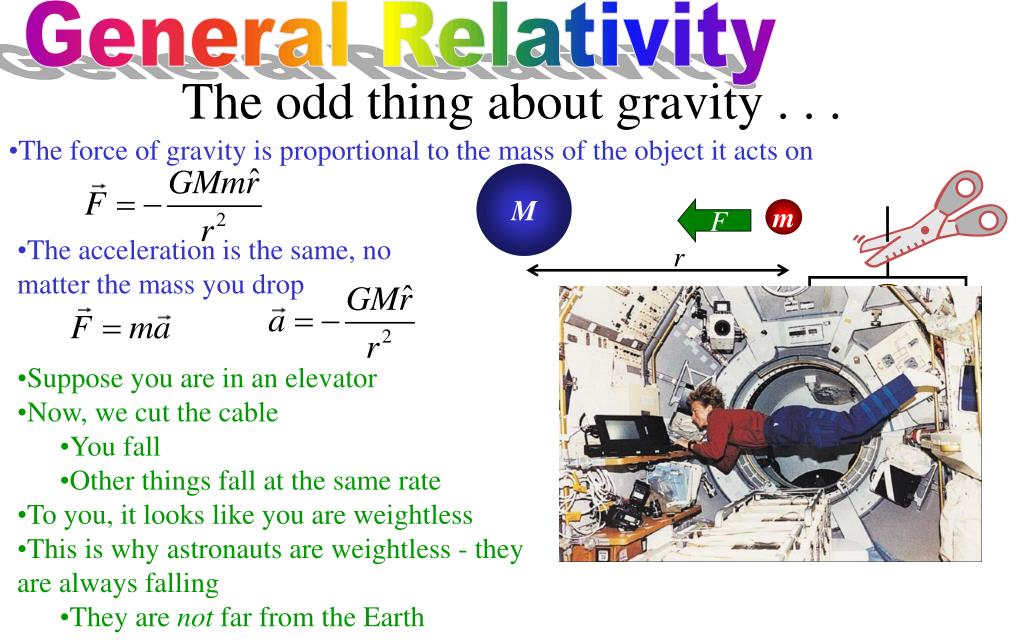
General Relativity The odd thing about gravity . . . • The force of gravity is proportional to the mass of the object it acts on M F m • The acceleration is the same, no matter the mass you drop r • Suppose you are in an elevator • Now, we cut the cable • You fall • Other things fall at the same rate • To you, it looks like you are weightless • This is why astronauts are weightless - they are always falling • They are not far from the Earth
The equivalence principle • Are there any other force formulas that are proportional to mass? • Suppose you are on a merry-go-round • Centrifugal force • Like gravity, everything “accelerates” equally • You can make it go away by letting go • Can we create “gravitational” effects through acceleration? • Put the person out in space in the elevator • Attach to an accelerating rocket • The effects are indistinguishable fromgravity The effects of gravity are indistinguishable from the effects of being in an accelerated reference frame
The metric again • We will start by reexamining the metric – the distance formula • Or in this case, the proper time formula • This formula works if you move in a straight line • What if you don’t move in a straight line? • You can divide any longer path into several short segments • Then, find the distance formula for each one • We won’t be using this formula • Interestingly, you can show that the straight line has the longest proper time path – called a geodesic An object with no forces acting on it will always follow a geodesic, which is the longest proper time path between two points in spacetime
Changing Coordinates • It is important to be able to change coordinates to a different system • Let’s change to spherical coordinates: (x,y,z,t) (r,,,t) • Similarly,
Moving in curved coordinates • The geodesic principle works in any coordinate system An object with no forces acting on it will always follow a geodesic, which is the longest proper time path between two points in spacetime • It is possible, starting from the metric, to find equations that describe geodesic motion
Moving in curved coordinates (2) • The effects of moving in curved coordinates looks like acceleration y • But it really isn’t • It is moving as straight as it can in curved coordinates • You can always eliminate this apparent acceleration, simply by returning to “flat” coordinates • It is possible, starting from the metric alone, to prove that spacetime is really just flat x
Curved Space • It is possible to live in a spacetime that is inherently curved • It’s not just the coordinates, it’s spacetime itself that is curved • Consider the surface of the Earth • Think of it as a 2D object • Imagine two explorers setting out from the North Pole in “straight lines” (geodesics) • At first they are traveling away from each other • When they reach the equator, they will be traveling “parallel” to each other; their distance is no longer increasing • They then start traveling towards each other • They meet at the south pole • The curvature is real • It is space itself that is curved, not the coordinates only
Curvature • How can we tell, looking only at the distance formula (the metric), if the curvature is real or a consequence of our coordinate choice? • The Riemann Tensor tells you if it is curved • If the Riemann tensor is zero, space is not curved; if it is non-zero, it is curved • Changing coordinates doesn’t make it go away • Some other measures of curvature: • The Ricci tensor: • The Ricci scalar: • The Einstein tensor:
The Stress-Energy Tensor V • What causes gravity? Energy and momentum • The presence of matter, or mass density, is the cause of gravity • Mass density is proportional to energy density • If energy makes a difference, why not momentum as well? • Momentum density also contributes to gravity • The flow of energy and momentum also causes gravity • Another way of looking at momentum density is the transfer of energy • It is like power flowing through an area • You can also transmit momentum across a boundary • This is what forces do • Pressure is a good example • A more general example is called the stress tensor P A F • Gravitational effects in general relativity are caused by the energy density u, the momentum density vector g, and the stress tensor
Einstein’s Equations • The central idea of Einstein: • Gravity looks just like acceleration, except • When you have a source of gravity, parallel doesn’t remain parallel • This tells you gravity has to dowith curvature M a m a m • The stress-energy tensor Tµmust be related to the curvature • Einstein found a relationship that worked, now called Einstein’s equations • It may look simple, but it isn’t • This is really 16 equations (since and each take on 4 values) • The expression on the left contains hundreds of terms • It is highly non-linear
Geodesics in curved spacetime • Why do particles curve under the influence of gravity? • Because spacetime itself is curved! An object with no non-gravitational forces acting on it will always follow a geodesic, which is the longest proper time path between two points in spacetime Matter tells space how to curve, andspace tells matter how to move
The Schwarzschild Solution • Assume you have a spherically symmetric source of gravity • Doesn’t matter how it’s distributed • You have to be outside it • The solution you get for the Metric is called the Schwarzschild Solution M • If you let M = 0, you get the same solution as before (flat spacetime) • The factors of 1-2GM/c2r are the only change • The change in the radial term (dr2) tells you that the relationship between radius and circumference isn’t the obvious one • C 2r ! • The dt2 term tells you that time runs more slowly when you are near a mass! Time slows down in proximity to a mass!
Gravitational time effects M • Suppose you are standing still (dr = d = d = 0) near a mass • Time runs more slowly f0,0 • This can be measured directly by comparing atomicclocks in airplanes vs. atomic clocks on the ground • Next generation atomic clocks: measure which floor you are on • GPS wouldn’t even work if they didn’t take GR into account f, • This has an important effect when studying spectral lines from high mass/small radius stars • The frequency f we observe away from the star’s gravitational field is increased compared to f0 • Since wavelength is inversely proportional to frequency, the wavelength observed is longer, “red shifted”
Gravitational Forces time fast • Why do objects accelerate in a gravitational field? time medium An object with no non-gravitational forces acting on it will always follow a geodesic, which is the longest proper time path between two points in spacetime • I want to toss a ball to myself – release it and catch it one seconds later, at the same place • What path should I take • Goal: maximize the proper time the ball experiences time slow • Strategy #1 – hope it levitates in place • Bad – it is stuck near the Earth, where time runs slowly • Strategy #2 – toss it very high in the air • Bad – high speed causes time to slow down too much • Strategy #3 – toss it moderately fast into the air • Good – a compromise – it gains effect of going away from Earth without too much speed
Gravitational Deflection of Light • Gravity affects all objects, because it is a curvature of spacetime • The effect is small, for the Sun, and almost impossible to measure except from space or during eclipses • For objects like galactic clusters, the effect is large and can be used to measure the mass of the cluster
Black Holes • There is a radius where the equation looks like it goes crazy • Called the Schwarzschild radius • This radius is inside the physical radius of the Earth, Sun, and all planets in the solar system • About 3 km for the Sun • The formulas are no longer valid here • If you managed to squeeze the Sun to this radius, something remarkable would happen • The Sun would become a black hole
Precession of the Perihelion • Newtonian gravity and General Relativity have almost the same predictions • Some slight discrepancies • Newtonian gravity says planets orbit the Sun in ellipses • General relativity says the direction of the ellipse slowly changes with time Mercury • This effect is called precession of the perihelion • Depends on the speed • Discovered, but not explained, before Einstein • For Mercury, it works out to 43 arc-seconds per century • This effect has since been seen in other systems • Spacecraft • Orbiting pairs of neutron stars Sun
Gravity Probe B • Four superaccurate gyroscopes that orbited the Earth from 2004-2005 • Accurate tests of special and general relativity Earth gyroscope • Two effects it is looking for: • As the object orbits, its motion andEarth’s gravity combine to make the directionof the axis tilt in the direction of motion • This motion is called the “geodetic effect” • April 2007: effect matches expectation at the 1% level • September 2009: effect matches expectation at the 0.1% level • The Earth is simultaneously rotating on ITS axis • It drags spacetime along with it. • This effect is called “frame dragging” • September 2009: effect matches expectation at the 15% level
Gravity Probe B
Gravitational Waves • Distortions of spacetime are produced by masses • Just like electromagnetic fields are produced by charges • If you have accelerating masses, you can make gravity waves • Just like accelerating charges make electromagnetic waves • These distortions affect everything that feels gravitational forces • i.e. everything • These effects are truly tiny • Motions ~ 0.01 fm • Several gravity wave detectors are looking for these effects • No positive results yet
Gravitational Wave Detection • The direct way to detect gravity waves is via interferometry • Make light interfere after going along two LONG paths • Extremely sensitive method • LIGO – Laser Interferometer Gravity Wave Observatory • Livingston, Louisiana • Hanford Washington • Indirect detection – • If two objects are circling each other, they must lose energy • They must move closer • Frequency of orbitincreases • Detected in Pulsar pairPSR 1913+16 • Hanford, Washington