Understanding Velocity: Definition, Formula, and Changes Explained
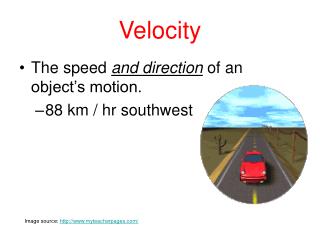
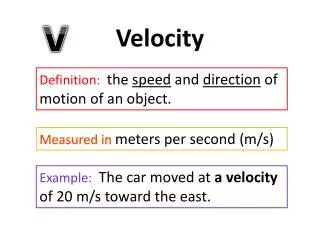
Velocity is defined as speed with a direction. To calculate velocity, use the formula ( V = frac{d}{t} ), where ( d ) is distance and ( t ) is time, resulting in units of m/s. For example, Luis rides his bike uphill at 6 miles/hour, while Bart skateboards downhill at 15 miles/hour. Velocity can change in three ways: alteration in speed, change in direction, or both. Consider a car turning left (change in velocity) versus a runner maintaining speed in a straight line (no change). Learn these fundamental concepts to grasp how motion works.

Understanding Velocity: Definition, Formula, and Changes Explained
E N D
Presentation Transcript
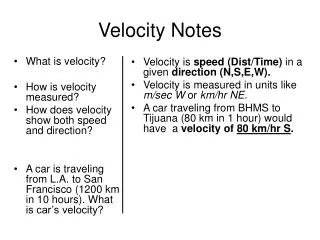
What is velocity? • Speed with direction
What formula is used to figure out the velocity of an object? • The formula for speed. • S = m/s
What is the velocity of the following? Luis is riding his bike up a hill at 6 miles/hour. • His velocity is 6 miles/hour uphill Bart is riding his skateboard downhill at 15 miles/hour. • His velocity is 15 miles/hour downhill.
Name 3 ways in which velocity changes • When speed changes (increasing or decreasing speed). • When direction changes. • When both speed and direction changes.
For each of the following write either ‘change in velocity’, or ‘no change in velocity’: A car turning left on a street Change in velocity A car stopping at a stop sign Change in velocity A runner running 7 m/s in a straight line No change in velocity A person riding on a merry go round Change in velocity A plane taking off Change in velocity
For each of the following write either ‘change in speed’, ‘change in direction’, or ‘change in both’ You are walking to class, but then you hurry and run to avoid being late. Change in speed Going through a loop on a roller coaster. Change in direction and speed. You run as fast as you can but then get tired and slow down. Change in speed