Understanding Metabolic Processes: The Chemistry of Life
This comprehensive overview explores the essential concept of metabolism, detailing the balance of anabolism and catabolism that characterizes living organisms. It covers the fundamental chemical processes occurring within cells, the role of isotopes, and important chemical bonding types. Key topics include the properties of water, the significance of acids, bases, and buffers in biological systems, and the implications of radioisotopes in medical research. Gain insight into the intricacies of life at the molecular level and the importance of maintaining homeostasis in living organisms.

Understanding Metabolic Processes: The Chemistry of Life
E N D
Presentation Transcript
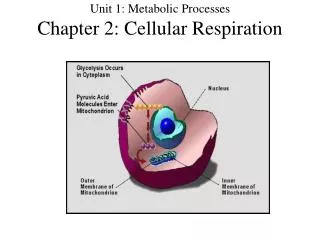
Metabolic Processes • What does that mean?? • The cell is a highly organized assembly of atoms and molecules programmed by genetic instructions to carry out chemical reactions that define “life”. • Living organisms are characterized by a balance of anabolism and catabolism. Together, they are called metabolism.
Metabolic Processes:Chemistry of Life Monday, March 1st Miss Tee
The Atom • Mass number: # protons, neutrons • Atomic number: # of protons • Isotope: atom of an element with same atomic number but different mass number
Isotopes • Nucleus of some isotopes spontaneously decays • We call these radioisotopes and they are radioactive • Radioactivity results in: • Formation of new element • Release of subatomic particles • Radiation
Half-life • Every radioisotope has a characteristic property: half-life • What is a half-life? • The time it takes for ½ atoms in a sample to decay • What application does this have for us today? • Radioisotopes emit radiation as they decay can be detected • Radioactive tracers are used to follow chemicals through reactions as they occur in the body • BIG medical research industry
Chemical Bonding • Orbital • Volume of space where electrons are most likely to be found • Can accommodate no more than 2 electrons • When 2 electrons pair up and occupy an orbital = more stable • Ion • Cation, anion (loss, gain of e-) • Ionic bond • Force of attraction between anion and cation • NaCl
Covalent Bonding • Atoms share electrons in outer shell, creating full shells for both • Diamond is a good example
Molecular Shape • Overall shape contributes to molecule behaviour • When atoms react to form covalent bonds, their valence electrons undergo “hybridization” • Change in orientation of the valence electrons • Since electrons are all –vely charged, the pairs will repel each other and will move as far apart as possible • Molecular shapes include: • Tetrahedral • Pyramidal • Angular • Linear
Water • H2O’s polar covalent bonds and asymmetrical shape create a highly polar molecule • Allows it to form chemical bonds with other molecules and ions • Bonds BETWEEN molecules are called “intermolecular bonds” • Intermolecular bonds weaker than intramolecular bonds • 3 types: • London Forces • Dipole-dipole forces • Hydrogen bonds
London Forces • Weakest, exist between all atoms and molecules • Formed by temporary unequal distribution of electrons as they move randomly about the nucleus • Transient “electron cloud” will attract positive nucleus of neighbour atom
Dipole-dipole Forces • Hold polar molecules together • Partially positive side of a molecule attracts the partially negative side of another molecule
Hydrogen Bonds • Especially strong dipole-dipole forces • Form only between electropositive H of one molecule and an electronegative N, O, or F atom of neighbour polar molecule
Van der Waals forces • London forces, dipole-dipole forces and hydrogen bonds are collectively referred to as “Van der Waals forces” • Electrostatic charges between adjacent atoms
Water as a Solvent • Small non-polar molecules (O2, CO2) cannot form hydrogen bonds with water only slightly soluble • That is why we need hemoglobin • Large non-polar molecules (fats, oils) also do not form hydrogen bonds • “hydrophobic” (opposite is…?)
Unique Properties of Water • Water clings • Cohesion • Adhesion • Water absorbs a lot of heat • High specific heat capacity • High specific heat of vaporization • Solid water is less dense than liquid water
Unique Properties of Water • Homework: • Make a table listing the 5 unique properties of water with: • A definition for each property • The effect of that property • An example of that property in everyday human or animal life • Prepare your unit glossary
Acids, Bases and Buffers • At 25°C, 2 H2O molecules/ 550 million react with each other • 1 H2O donates an H+ to the other H2O molecule OH-, H3O+ • This is called “autoionization”
Acids, Bases and Buffers • What is an acid? Base? • An acid is a proton donor; a base is a proton accepter • What do you know about pH and the human body? • Internal environment of multicellular organisms is very sensitive to pH levels • Most cellular processes operate best at pH 7.0- 7.4 • Living cells use “buffers” (proton accepting/donating system) to resist significant changes in pH
Acids, Bases and Buffers • The most important buffer to the human body is carbonic acid (H2CO3) and bicarbonate (HCO3-) buffer system
Buffers • Acidosis and alkalosis can be serious medical conditions, potentially fatal • Internal buffers can donate H+ ions when they are required (if a patient is alkalotic) and can remove H+ ions when there are too many in a solution (if a patient is acidotic). • They are reversible reactions.