An Agile ETL Data Development for ERA XML Submission
240 likes | 365 Vues
This paper explores the challenges and solutions associated with Agile ETL (Extract, Transform, Load) data development for the ERA XML submission process at the Australian National University. It highlights the complexities of the system, emphasizing the need for a flexible approach to meet operational constraints such as data quality, timely delivery, and resource efficiency. The discussion includes insights into a Commercial-Off-The-Shelf (COTS) system architecture, data transformation strategies, and the importance of domain knowledge to navigate the intricacies of different XML schemas.


An Agile ETL Data Development for ERA XML Submission
E N D
Presentation Transcript
An Agile ETL Data Development for ERA XML Submission Dr Paul Wong Research Office, Australian National University
ERA – A Complex System? Some characteristics of Complex Systems • Many actors / stakeholders • Actors / stakeholders form a network (of interactions) • Interactions produce emergent behaviours • Nonlinearity – effects disproportional to (small) changes • Uncertainty and unpredictability • Feedback loops – blurring of cause and effect
IT / Data Solution in a complex environment • Technically sound • Meet the operational constraints • Quality (Good) • Time to delivery (Quick) • Resource (Cheap) • Cope with the complexity (for us, uncertainty and change) • Agility
Contractor In-house In-house Triple Concurrent Development
Contractor In-house Semi-Concurrent Development
The Technical Challenge • XML • Validation against XML schema • Enterprise data stored in relational data structure • Transformation from relational to XML structure Proposition: It is impossible to implement a fully automatic (and correct) algorithm to transform a given set of data to an xml file (valid) in an arbitrary but given xml schema.
Implications • Cannot program once and reuse the same program for every xml schema of the eight discipline clusters • Depending on specification overlap, in the worst case 8 distinct ETL systems will be required • Hard to estimate time and cost for programming without information of the actual schemata • Domain knowledge (and hence human intervention) is necessary to map data across different schemata.
The Technical Solution • Commercial-Off-The-Shelf (COTS) system architecture • A blue print of how components fit together to form the whole system to deliver the required functions • Build methodology • A systematic method to build the underlying system • Skill, knowledge and understanding • Technical know-how • Interpret business rules, government guidelines, internal organisation processes and policies
Intermediate Database Schema • Intermediate database schema is “isomorphic” to the target XML schema • most work is done in the intermediate database • no high power programming is required, standard SQL will do • detailed knowledge of the enterprise data is required
Main Features of the Architecture • Plug into the database backend of any Research Management Information System • Two-pass process of data transformation • First pass takes a snap shot of enterprise data • Provide an intermediate step for data cleansing, implementing V&V rules and data debugging • Intermediate database schema is “isomorphic” to the final target XML schema – simplify data mapping downstream • No high power programming required, SQL will do
To Cut a Long Story Short We have • a COTS system architecture • a Build methodology • A systematic method to build the underlying system • relevant knowledge • technical know-how • interpret business rules, government guidelines, internal organisation processes and policies
From Technical to Operational Challenges We need • Good – data quality must pass the final V&V in SEER • Quick – must be delivered on time to SEER • Cheap – must be within the limit of available resources In addition • embrace complexities, changes and uncertainties – must become more agile.
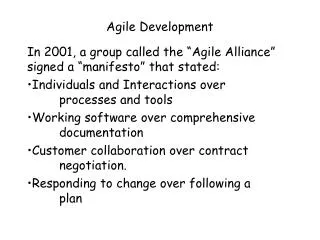
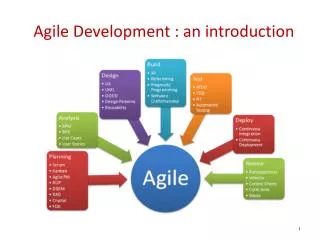
Agile Software / System Development • New breed of software / system development methodology – offspring of rapid prototyping • Short iterative development cycles with lightweight processes • Incremental – add functionalities as we go • Tacit knowledge – instead of documentation • Self-organising – collective decision • Emergence – work structure to be realised during the project instead of a predefined plan
Plan-driven Development • Traditional approach based on standard engineering practice • Development moves through a sequence of predefined and standardised processes • Development phases cannot be easily altered, e.g. no implementation before specification • Requires completeness of documentation at each phase of the development • Requires “sign off” at each phase of the development • Roles, responsibilities and work structure are predefined, monitored and controlled accordingly.
Agile Development Time change
Plan-Driven Development Time change
Balancing Optimizing and Adapting Dimensions (Boehm and Turner 2003, page 47) The People Factor
Conclusion • Technical – sound • Complexity – the right mix people and methodology • Operational • Good – pass the gold bar V&V in SEER • Quick – submitted on the first day SEER was opened • Cheap – ???
Questions, Comments, Abuses? Paul.Wong@anu.edu.au