Understanding Transport Processes in Surface Waters: Emission, Immission, and Mass Balance
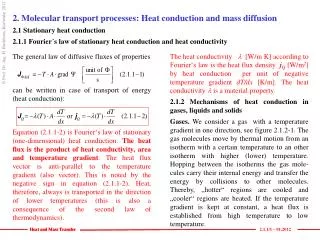
This presentation explores the crucial transport processes in surface waters, focusing on the emission and immission of pollutants and their impact on the environment. We analyze the physical, chemical, and biochemical processes that govern the fate of pollutants in water, including advection, diffusion, and degradation. Key concepts such as conservation of mass, state variables, and mass balance equations are discussed to model the concentration distribution over time and space. Our aim is to improve water quality by managing emissions effectively, utilizing analytical and numerical approaches.

Understanding Transport Processes in Surface Waters: Emission, Immission, and Mass Balance
E N D
Presentation Transcript
Transport processes • Emission – [mass/time] pollutants released into the environment • Imission – [mass/volume] amount of pollutants received by a living being at a given location. Also, the state of the environment with respect to the pollutant • Transmission Everything between emission and immission.
Transport processes What is a transport process? • Describes the fate of any material in the environment • The continuous steps of transportation, reactions and interactions which happen to the pollutants • It determines the concentration-distribution of the observed material in time and in space • Transmission
Transport processes Transport processes include: • Physical transportation due to the movement of the medium • Advection • Diffusion and dispersion • Physical, chemical, biochemical conversion processes: • Settling • Ad- and desorption • Reactions • Degradation, decomposition
Transport processes What is our aim? • Defend our values • Decrease the immission by controlling the emission – EFFORT, MONEY! • Describe transport processes
Transport processes Important concepts: • State variable: concentration, density, temperature… • Conservative material: no reactions, no settling • Non-conservative material: opposite, realistic • Flow processes: 3D, u(x,y,z,t), h(x,y,z,t), V(x,y,z,t),… • Steady state: du/dt=0, dC/dt=0,… • Homogeneous distribution – totally mixed reactor
Transport processes This presentation deals only with transport processes in surface waters. So the transporting medium is water. Classical water quality state variables are: • Dissolved oxygen (DO) • Organic material - biochemical oxygen demand (BOD) • Nutrients – N-, P-forms (NO3-N, PO4-P,…) • Suspended solids (SS) • Algae
OUT (2) (1) Controlling surface V IN Mass balance General mass balance equation: • Expresses the conversation of mass! • Differential equations IN – OUT + SOURCES – SINKS = CHANGE We work with mass fluxes [g/s]
Mass balance By solving the general mass balance equation we can describe the transport processes for a given substance. Solution: • Analytical • Numerical Discretization: • Temporal • Spatial • Boundary, initial conditions: • Geometrical DATA • Hydrologic DATA • Water quality DATA • Simplifications: • Temporal – steady-state • Spatial – 2D, 1D • Other
Simplified case I. IN – OUT + SOURCES – SINKS = CHANGE Assumptions: • Steady state • Conservative material Solution • IN=OUT • SOURCES=0, SINKS=0 • CHANGE=0
H vs Simplified case II. Assumptions: • Steady state – Q(t), E(t) are constants, dC(t)/dt=0 • Non-conservative, settling material (vs) • Prismatic river bed – A, B, H are constants • 1D A ~ B·H [m2]
(1) (2) Q Q Av Simplified case II. x IN: OUT: C(x) is linear (assumption) LOSS: settled matter
v vs The calculation Simplified case II. If x=O C=Co Exponential decrease
E E=q·c emission Dilutionratio Determination of C0 value Simplified case II. Cbgbackgroundconcentration C0 concentration under the inlet Q 1D – Complete mixing (two water mixing with each other) Increment:
Dilution Sedimentation The solution Simplified case II. Transmission coefficient Conservative matter!!!
The general situation • Unsteady • Inhomogeneous • Non-conservative • 3D General transport equation: Advection-Dispersion Equation (ADE)
Advection-dispersion Equation • Can be derived from the mass balance. • Expresses the temporal and spatial changes of the observed state variable • It’s solution is the concentration-distribution over time • Differential equation Change due to diffusion or dispersion Change due to conversion processes Change in concentration with time Change due to advection = + +
v CONVECTION Molecular diffusion DIFFUSION
c1 c2 x Fick’sLaw Molecular diffusion • c1 c2 separated tanks • open valve • equalization and mixing • (Brown-movement) • depends on temperature Mass flux (kg/s) through area unit D - molecular diffusion coefficient [m2/s]
dz dy dx Mass balance equation IN: conv + diff OUT: conv + diff x direction IN OUT • convection • diffusion CHANGE
dz dy dx Mass balance equation IN: conv + diff OUT: conv + diff x direction
Convection Diffusion Mass balance equation Convection: transfering Diffusion: spreading If D(x) = const. in x direction Convection - Diffusion 1D Equation The other directions are similar
Mass balance equation x, y, z directions (3D): Convection: The water particles with different concentrations of pollutant move according to their differing flow velocity Diffusion: The adjacentwater particlesmix with each other, which causes the equalization of concentration D – molecular diffusion coefficient material specific, water: 10-4 cm2/s space independent slow mixing and equalization
v*deviation, pulsation 0 Turbulence • Laminar flow: ordered with parallel flow lines • Turbulent flow: disordered, random (flow and direction) because of surface roughness (friction) → causes intensive mixing • Natural streams: always turbulent v (c) average t T Time step of the turbulence We usually can use the average only!!
Turbulent transport description Convection:v·c [ kg/m2·s ] 0 ? 0
v turbulent diffusion molecular diffusion Turbulent diffusion X direction (the other are similar) Analogy with Fick’s Law → the original transport equation does not change, only the D parameter Dtx, Dty, Dtz>> D Depends on the direction Function of the velocity space!!!
3D transport equation in turbulent flow Dx = D + Dtx, Dy = D + Dty, Dz = D + Dtz Temporal averaging (T) Convection Diffusion Turbulent diffusion Stochastic fluctuations of the flow velocity (pulsations) Diffusive process in mathematical sense (~ Fick’s Law) Convective transport!!! (temporal differences)
x H v z Spatial simplifications (2D) - Dispersion Velocity depth profile Depth averaged flow velocity Depth Integration (3D2D) v 0 After the expansion of the convectiv part (v ·c) in x direction Turbulent dispersion (~ diffusion)
2D transport equation in turbulent flow (depth averaged) Dx*, Dy*turbulentdispersion coefficients in 2D equation Depth averaging (H) 1D transport equation in turbulent flow (cross-section av.) Dx**turbulentdispersion coefficient in 1D equation Cross-section averaging (A)
v Turbulent dispersion Convectiv transport arising from the spatial differences of the velocity profile (faster and slower particles compared to the average) In the 2D and 1D equations only! Dispersion coefficient: a function of the velocity space (hydraulic parameters, channel geometry) Dx* = Ddx+ Dtx + DDy* = Ddy+ Dty+ D Dx** = Ddxx + Ddx+ Dtx + D Dx*, Dy* >> Dx Dx** >> Dx* In case of more irregular channel and higher depth or larger cross-section area its value is bigger Also present in laminar flow
1. settling 2. settling X2 X - efficiency ( 0 , 1 ) X1 FOLYÓ E - BOD5 emission E2 E1 LAKE 2 3 Industrial use bath (CR3) (O2 standard, CR2) 1 REGIONAL PROBLEM: COST EFFICIENT SOLUTION • Immission standard C2 + a12E1X1 CR2 a - coefficient of transport C3 + a13E1X1 + a23E2X2 CR3 C2, C3 – present state (monitor)
1 xU C2 + a12E1X1 CR2 C3 + a13E1X1 + a23E2X2 CR3 xL xL xU 1 • FIRST STEP x2 x1 • SECOND STEP WHAT WAS NOT APPLIED? min [K1(X1) + K2(X2)] FUNCTION WE NEED min [k1X1 + k2X2] LINEAR TYPE • SOLUTION IS THE COST FUNCTION OK?
1 xU xL xL xU 1 • CONDITION (1) and (2) x2 • “RELATIVE” IMPORTANCE • ENGINEER AND RESEARCHER • OUTLET • TECHNOLOGICAL LIMIT • MINIMUM NEED x1 • “EVEN” STRATEGY • AFTER THIS: DEFINE COSTS AND FACTOR TRANSPORT