Understanding Chemical Reactions: Energy, Bonds, and Demonstrations
This presentation by Mr. Mark Langella at STANYS 2006 delves into the intricacies of chemical reactions and what drives them, focusing on Gibbs Free Energy and spontaneity. It explores synthesis (combination) reactions where reactants form a single product (e.g., Mg + O2 = MgO) and provides demonstrations of reactions including the combustion of magnesium and various metal reactions with halogens. It also covers decomposition reactions and their general forms, highlighting energy changes, light emission, and real-life examples such as carbonate decomposition.


Understanding Chemical Reactions: Energy, Bonds, and Demonstrations
E N D
Presentation Transcript
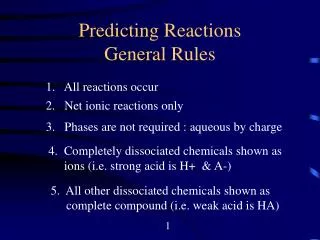
Predicting Reactions Presented by Mr. Mark Langella STANYS 2006 PWISTA.com 11/7/06
Why do the reactions occur? • Gibbs Free Energy drives the Spontaneous reactions • Lower PE energy • Formation of Stronger Bonds • Greater Entropy ( Formation of Gases) • Solubility • Formation Constant • Lose Yourself in Chemical Reactions - Google Video
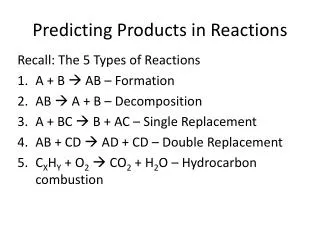
Synthesis or Combination Reactions • In synthesis or combination reactions, two or more substances combine together to form a single product. • The general form is A + B C • The products must contain only those elements found in the reactants.
Metal + Nonmetal Salt • Magnesium ribbon is burned in oxygen
Combination or Synthesis Reactions • General form • A + B C • In this demonstration • 2 Mg + O2 MgO • 3 Mg + N2 Mg3N2 • The oxygen and nitrogen occur naturally in the atmosphere • O2 is 21% of air • N2 is 78% of air
Energy • Two types of energy are produced in this demonstration • heat energy DHf MgO = -601.83 kJ/mole (kiloJoules per mole) • this is said to be the ‘heat of formation’ for MgO • the negative sign indicates the formation is exothermic • light energy • approximately 10% of the energy of combustion occurs as light in this demonstration • more light than any other known reaction
Online Demos • Reaction of Iron and Sulfur • http://www.pc.chemie.uni-siegen.de/pci/versuche/pics/anim/fes.mpg • Fe + S FeS • Reaction of Potassium and Oxygen • http://neon.chem.ox.ac.uk/vrchemistry/FilmStudio/alkalimetals/HTML/page08.htm • Reaction of Lithium and Oxygen • http://neon.chem.ox.ac.uk/vrchemistry/FilmStudio/alkalimetals/HTML/page02.htm • Reaction of Lithium and Chlorine • http://neon.chem.ox.ac.uk/vrchemistry/FilmStudio/alkalimetals/HTML/page04.htm • Reaction of Sodium and Oxygen • http://neon.chem.ox.ac.uk/vrchemistry/FilmStudio/alkalimetals/HTML/page05.htm • Reaction of Zinc and Sulfur • http://boyles.sdsmt.edu/znsulf/zincsul.htm
Nonmetal + Nonmetal Molecular compounds • Reaction of Hydrogen and Oxygen • http://www.chem.uiuc.edu/clcwebsite/video/Bal2.mov
Reaction of Phosphorus and Chlorine • http://boyles.sdsmt.edu/pwithcl/DirksTwo.asx • P4(s) + 10 Cl2(g) 4 PCl5(s) • Oxidation Number Changes
Nonmetal Oxide + Water Oxyacid • Oxy Acid= Contains H+ ions attached to common Polyatomic ion of Nonmetal Oxide plus one more oxygen
Formation of Carbonic Acid • Carbon dioxide and Water- Carbon Dioxide is easily produced by the reaction of sodium bicarbonate and vinegar. • http://boyles.sdsmt.edu/respira/AlexanderCo2Blue.asx
Reaction of Carbon Dioxide and Limewater • http://boyles.sdsmt.edu/respira/AlexanderCo2White.asx • CO2(g) + Ca(OH)2(l) CaCO3(s) + H2O(l)
DECOMPOSITION REACTIONS • Substances break down by means of decomposition reactions • The general form of a decomposition reaction is • C A + B • Decomposition reactions are the opposite of combination or synthesis reactions
Decomposition of Metal Carbonate • Heating a metal carbonate always yields the metal oxide and carbon dioxide. • MCO3 MO + CO2 • Heating the carbonates • Most carbonates tend to decompose on heating to give the metal oxide and carbon dioxde. • For example, a typical Group 2 carbonate like calcium carbonate decomposes like this: • In Group 1, lithium carbonate behaves in the same way - producing lithium oxide and carbon dioxide. • The rest of the Group 1 carbonates don't decompose at Bunsen temperatures, although at higher temperatures they will. The decomposition temperatures again increase as you go down the Group.
Metal Hydrogen Carbonate Decomposition • Heating a metal bicarbonate gives the metal oxide, carbon dioxide, and water. • MHCO3 MO + H2O + CO2 • Solid Sodium Hydrogen Carbonate is strongly heated
Metal Chlorate Decomposition • Heating a metal chlorate gives the metal chloride plus oxygen. • MClO3 MCl + O2 • Burning Gummi Bears • http://www.webct.com/service/ViewContent?contentID=1249557&communityID=858&categoryID=1249537&sIndex=0 • Logger Pro Analysis
Decomposition of Ammonium Dichromate • http://boyles.sdsmt.edu/dichrom/AmmoniumDichromate.asx • (NH4)2Cr2O7(s) Cr2O3(s) + N2(g) + 4H2O(g)
Peroxide Decomposition • Elephant’s Toothpaste • Website: • http://boyles.sdsmt.edu/tpaste/Cain.asx • Genie in a Bottle Demo • Website: http://boyles.sdsmt.edu/geniebot/genie.htm
Reactions Based on Reduction Potentials EMF Potential • Reduction and Oxidation • Single replacement
Cation Replacement • There are two types of single replacement reactions, in one, a metal or hydrogen replaces a positive ion • M0 + A+B- M+B- + A0
Reaction of Sodium and Water http://boyles.sdsmt.edu/sodwat/SodiumWater.asx http://www.theodoregray.com/PeriodicTable/Stories/011.2/Videos/SodiumResearch03.html http://www.theodoregray.com/PeriodicTable/Stories/011.2/Videos/SodiumResearch02.html Sodium(s) + Water(l) Sodium Hydroxide(aq) + Hydrogen(g) • 2Na(s) + 2H2O(l) 2NaOH(aq) + H2(g)
Reaction of Potassium and Water • http://www.chem.shef.ac.uk/webelements-moov/K_H2O.mov • http://www.theodoregray.com/PeriodicTable/AlkaliBangs/019_K_doghowls.html • Potassium(s) + Water(l) Potassium Hydroxide(aq) + Hydrogen(g) • 2K(s) + 2H2O 2KOH + H2(g) • Group I with water video • http://video.google.com/videoplay?docid=-2134266654801392897&q=rubidium+water
Reaction of Zinc and Tin (II) Chloride • http://www.chemtopics.com/lectures/unit02/lecture1/displace.htm • Zinc(s) + Tin (II) Chloride(aq) Tin(s) + Zinc (II) Chloride(aq) • Zn(s) + SnCl2(aq) Sn(s) + ZnCl2(aq) • Zinc(s) + Hydrochloric Acid(aq) Zinc (II) Chloride(aq) + H2(g) • Zn(s) + 2HCl(aq) ZnCl2(aq) + H2(g) • Aluminum and Copper ( II) Chloride
Thermite Reaction • 2Al(s)+Fe2O3(s) Al2O3(s)+2Fe(l) • http://boyles.sdsmt.edu/thermite/ThirstrupThermiteClose.asx • http://www2.chemie.uni-erlangen.de/education/medprak/videos/thermit_v.mpg • http://video.google.com/videoplay?docid=-7231843493488769585&q=Reactions&hl=en
Aqueous Redox ReactionsOxidation States of Manganese • Procedure • Add 30 ml of a .01 M KMnO4 solution to four small flasks labeled A , B, N ( Place Tablet 1/10 ml water) • To Flask A, Add 10 ml of 3M H2SO4 • MnO4- + H+ • To Flask B, add 10 ml of 5 M NaOH. • MnO4- + OH- • To Flask N add nothing. • MnO4-
Watch the color changes • To Flask A add .01M NaHSO3 ( Tablet 2) slowly till you get a colorless Mn2+ ion. • MnO4- + 5H++ HSO3- 3H2O + 2Mn2+ + 5SO42- • To Flask N add .01M NaHSO3 ( Tablet 2)until a brown precipitate forms. • 2MnO4- + 3HSO3- 3SO42- + H++ H2O +MnO2 • To Flask B slowly add .01M NaHSO3 ( Tablet 2) until a green solution forms. • 2MnO4- + OH-+ HSO3- 2MnO42- + 2H2O + SO42-
The Amazing Purple Drop • Oil Drop Demo • I2 + H20 HOI ( aq) + HI ( aq) • Meanwhile • I2 + 2e- = 2I-, Eo = 0.54 v • HCHO + 2H+ + 2e- = CH3OH, Eo = 0.19 v
Reactions Driven by • Solubility and Precipitation • Formation of Gases ( Increase in entropy) • Formation of Water • Coordinate Covalent Bond Formation ( Lewis Acid-Base) • Formation Constants
Formation of Water • Metal Oxide + an Acid Salt + Water • Metal Hydroxide + an Acid Salt + Water • (a special type of reaction called neutralization) • Milk of Magnesia Demo
PREDICTIONS BASED ON SOLUBILITY • If one or both of the products in the double replacement reaction is insoluble in water, the reaction will occur. • Reaction #1 • Lead Nitrate and Sodium Chromate • Pb(NO3)2 (aq) + Na2CrO4 (aq) PbCrO4 (s) + Na NO3(aq) • Pb 2+ + CrO42- PbCrO4 (s) • Reaction # 2 • Silver Nitrate and Hydrochloric Acid • AgNO3(aq) + HCl(aq) AgCl (s) + HNO3 (aq)
SOLUBILITY RULES FOR COMMON IONIC COMPOUNDS IN WATER • 1. All nitrates, chlorates, and acetates are soluble in water. Silver acetate is sparingly soluble. • 2. Most common acids are soluble in water. • 3. All common IA, and ammonium compounds are soluble in water. • 4. All chlorides, bromides, and iodides are soluble in water except silver, mercury (I), and lead. HgI2 and HgBr2 are insoluble in water. • 5. All sulfates are soluble in water except CaSO4, SrSO4, BaSO4, PbSO4, Hg2SO4. Ag2SO4 is sparingly soluble in water. • 6. All carbonates, phosphates, oxides, and sulfites are insoluble in water but soluble in dilute acids except the IA and ammonium compounds. • 7. The sulfides of all metals are insoluble in water except the IA, IIA, and ammonium sulfides. • 8. All hydroxides are insoluble in water except the IA, Ca(OH)2, Sr(OH)2, and Ba(OH)2 hydroxides.
Combustion • Whoosh Bottle • Rocket Explosions • Dynamite Soap Mixtures • Repeating Exploding Flask