Grievance Procedures
Grievance procedures are vital in labor-management relationships, ensuring that employees can address disputes effectively within the framework of contractual agreements. The fundamental principle of "Obey now, grieve later" emphasizes compliance while allowing for future reevaluation of disputes. These procedures protect contractual rights, promote fairness, and keep most employment disputes out of courts. The evolution of grievance arbitration, particularly post-WWII, has solidified its importance, offering a structured way to resolve disagreements and adapt to changing workplace conditions.

Grievance Procedures
E N D
Presentation Transcript
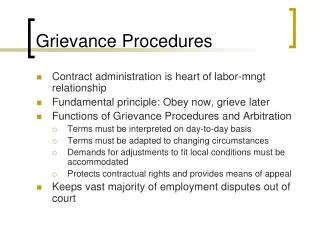
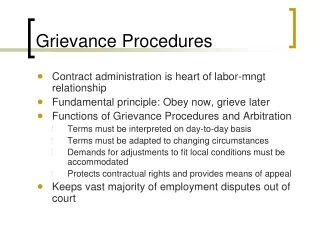
Grievance Procedures • Contract administration is heart of labor-mngt relationship • Fundamental principle: Obey now, grieve later • Functions of Grievance Procedures and Arbitration • Terms must be interpreted on day-to-day basis • Terms must be adapted to changing circumstances • Demands for adjustments to fit local conditions must be accommodated • Protects contractual rights and provides means of appeal • Keeps vast majority of employment disputes out of court
Issues in Contract Administration • Discipline • Discharges often grieved, regardless of merit, for political reasons • Work assignments • What job classification gets work? (Job security issue) • Individual job assignments • E.g., promotions, layoffs • Supervisors doing production work • Working conditions • Health and safety • Subcontracting • Past practice • E.g., eliminating clean-up time 15 minutes prior to end of shift
Grievance Procedures • Grievance Procedure Structure • Effects of Grievance Activity on Productivity • Research shows that plants w/ high grievance rates perform worse than those w/ low rates
Grievance Arbitration • Historical Evolution • War Labor Board (WWII) stimulated widespread adoption of grievance arbitration • “Steelworkers Trilogy” solidified role • Courts should not consider merits of G. when deciding whether case should be arbitrated • All disputes arising out of CBA should be resolved by arbitration, unless issue is specifically excluded (arbitration is quid pro quo for giving up strike) • Court should not review substantive merits of arbitration decision (only whether due process procedures were followed)
NLRB deferral to arbitration • G. over CBA clause may allege ULP • E.g., Er gives work to nonU Ees outside barg unit • G. would claim violation of CBA, ULP would claim discrimination • Where G. contains ULP, NLRB will defer to arbitration provided: • Parties agreed in CBA to be bound by arbitration • Proceedings were fair and regular • Result is not inconsistent w/ NLRA
Arbitration Procedures • Selection • Ad hoc (more common) or permanent umpire • Presentation • Comparable to court proceedings (examination and cross), rules of evidence more liberal
Discipline • Just Cause • Clear and convincing evidence that disciplinary offense was committed by G. • Disciplinary action taken was appropriate for offense committed • See Table 9.7: “Seven Tests” • Considerations • Purpose of Discipline • Corrective, not punitive • Work rules must be reasonable, clear, state possible consequences of violation, be administered consistently
Discipline • Considerations • Progressive Discipline • Discharge is final step • Burden and degree (quantum) of proof • Burden for all disciplinary actions rests w/ mngt • Degree • Beyond reasonable doubt • Clear and convincing • Preponderance
Discipline • Considerations • Nature of Penalty • Few offenses merit discharge for single act • Arbitrators reluctant to modify suspensions, less hesitant to reduce discharge to suspension • Arbs look to previous practices, ‘precedents’ established by other arbitrators if no previous practice
Discipline • Considerations • Mitigating circumstances • Mngt contributed to problem and must assume some responsibility • Ee’s work record • Long, good record might mitigate even serious offense • Patterns • In discharge cases, discharge upheld ~50% of time • Full back pay, 20% • Partial back pay, ~10% • No back pay, ~ 20%
Grievance Procedures • Evaluation • Wildcat strikes • G. procedures effective in avoiding • Time delays and cost • Average time from filing of G. to award over 6 months • Cost to each side of one-day arbitration may be several thousand dollars • Expedited arb developed as alternative, esp. in discipline cases • No lawyers, transcripts, briefs
Rights and Responsibilities • Duty of Fair Representation • In return for right to exclusive representation, U must represent all members of barg unit fairly and in good faith • Violations include arbitrarily ignoring meritorious G., processing G. in perfunctory manner, bad-faith conduct, refusal to handle due to personal hostility • Unions increasingly reluctant to drop grievances of questionable merit short of arbitration for fear of being sued • Ee’s Right to Representation • Ee who believes that discipline will result from meeting with management has right (given U.S. Supreme Court’s interpretation of Section 7) to insist that union representative be present (Weingarten rights) • NLRB in 2004 reversed NLRB’s 2000 decision to extend Weingarten rights to non-union employees
Non-union Workplace Dispute Resolution • Basic element of formal nonunion dispute resolution procedures is open-door policy formalized by specifying process for appealing decision of worker’s immediate manager • One or more elements sometimes added to this basic nonunion grievance procedure: ombudspersons, peer review panels, and arbitration
Compulsory Arbitration of Employment Disputes • U.S. Sup Ct has allowed (non-union) employers to impose as condition of employment requirement that any employment dispute be resolved by arbitration (even a dispute arising from statutory right, such as Title VII) • Issues: • Cost • Arbitrator selection • Limits on awards