Understanding Bacteria: Characteristics, Movement, Nutrition, and Classification
Bacteria are prokaryotic, single-celled organisms that lack a nucleus and organelles like mitochondria. They come in various sizes and shapes, including spherical (cocci), rod-like (bacilli), and spiral (spirochete). Bacteria can be autotrophs, producing their own food from sunlight or chemicals, or heterotrophs, which consume organic matter. The Gram staining technique classifies bacteria based on their cell wall structure: Gram-positive bacteria have thick peptidoglycan and one membrane, while Gram-negative have thinner peptidoglycan and two membranes, exemplified by E. coli and S. aureus.

Understanding Bacteria: Characteristics, Movement, Nutrition, and Classification
E N D
Presentation Transcript
Bacteria Notes Page 266
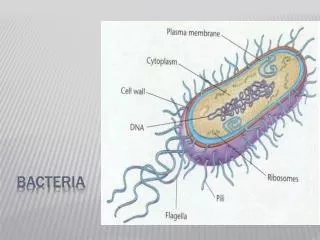
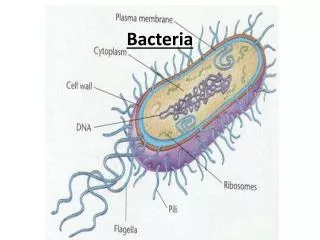
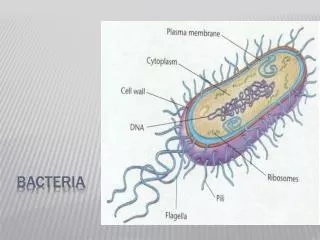
Bacteria: • Prokaryotes, so single-celled organisms without nucleus and other organelles like mitochondria
Flagella: • A long, whip-like structure that helps the cell move
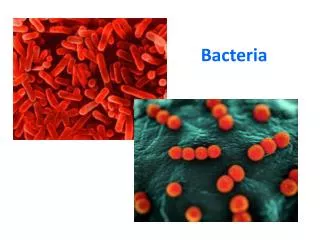
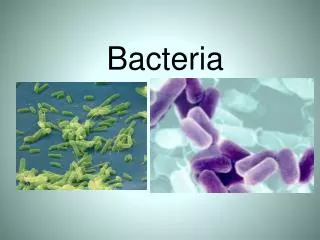
Size and Shape: • Vary in size • Spherical (cocci) • Rod-like (bacilli) • Spiral (spirochete)
Food • Some are autotrophs(make food from sun or chemicals) and some are heterotrophs(consume other food) • When your milk or meat spoils, it’s because a heterotroph has been eating it!
Gram Staining • A chemical process to classify different bacteria • Gram + have thick peptidoglycan and 1 membrane • Gram – have thin peptidoglycan but 2 membranes