Information Visualization: Enhancing Cognitive Understanding
Learn how to design interactive visual representations to amplify cognition. Explore the relationship between income and education, outliers in data, and more. Course mechanics and research focus provided.

Information Visualization: Enhancing Cognitive Understanding
E N D
Presentation Transcript
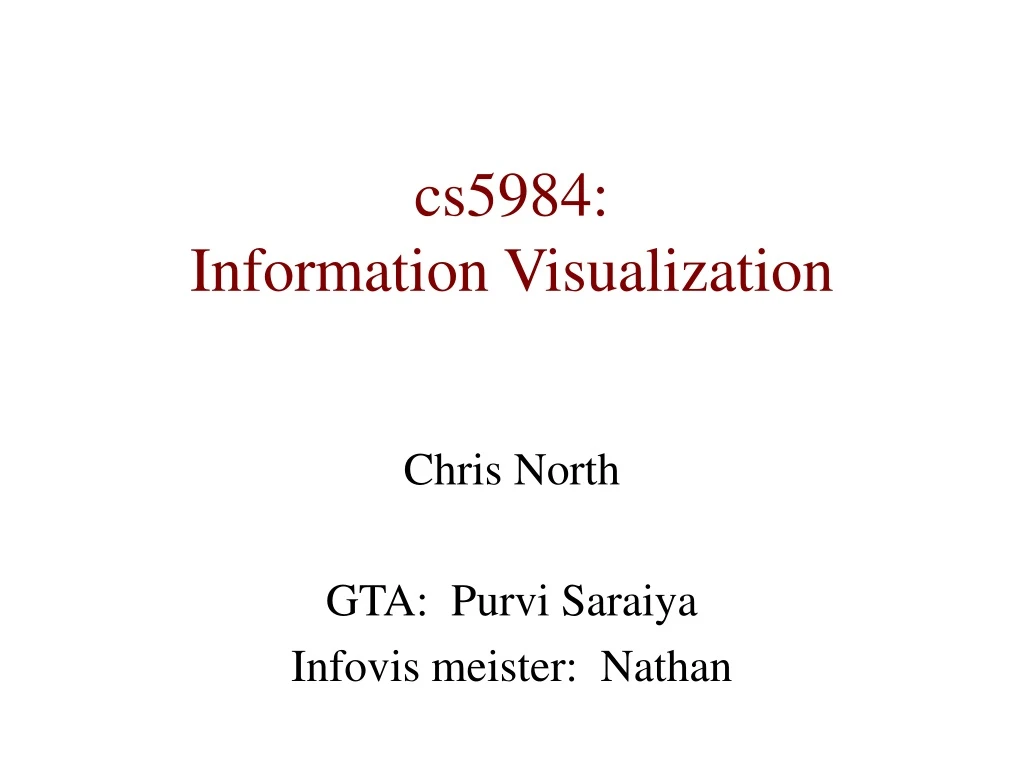
cs5984: Information Visualization Chris North GTA: Purvi Saraiya Infovis meister: Nathan
What is Information Visualization? • The use of computer-supported, interactive, visual representations of abstract data to amplify cognition
The Big Problem Web,books, papers, game scores, Scientific data, Biotech, Shopping People Stock/finance News Human Data Data Transfer How? Vision: 100 MB/s Ears: <100 b/s Telepathy Haptic/tactile Smell taste
Human Vision • Highest bandwidth sense • Fast, parallel • Pattern recognition • Pre-attentive • Extends memory and cognitive capacity • (Multiplication test) • People think visually Impressive. Lets use it!
Which state has highest Income? • Relationship between Income and Education? • Outliers?
College Degree % Per Capita Income
What if you could only see 1 state’s data at a time? (e.g. Census Bureau’s website) • What if I read the data to you?
Interactive Graphics • Homefinder
More than just “data transfer” • Support the ability to glean higher level knowledge from the data • Learn = data knowledge Insight!
Optimization: My Philosophy • Computer • Serial • Symbolic • Static • Deterministic • Exact • Binary, 0/1 • Computation • Programmed • Follow instructions • Amoral • Human • Parallel • Visual • Dynamic • Non-deterministic • Fuzzy • Gestalt, whole, patterns • Understanding • Free will • Creative • Moral Visualization = the best of both Impressive computation + impressive cognition
You will learn how to: * • Design visual, interactive representations • Critique existing designs • Development visualization software • Empirically evaluate designs An HCI focus • A visualization = a user interface for data
Related Courses • Scientific Visualization (ESM4714) • Computer Graphics (4204, 6xxx) • Usability Engineering (5714) • Research Methods! (5014) • Model & Theories of HCI (5724) • User Interface Software (5984) • Info Storage & Retrieval (5604) • Databases (5614)
Course Mechanics • Grading: • 10% Paper presentation & discussion • 30% Homeworks • 60% Project • Format: • Research class • Read research papers • Discussion • Contribute to research, Project! • dude.cs.vt.edu
Research Class • Creativity • No “right” answer • Reasoning/argument is more important • Self motivation • Open ended • Contribute to the state-of-the-art • Jump start for thesis research
Research = Learning the state-of-the-art + Creativity (Design) + Science (Measurement,Modeling) + Dissemination = project
HW #1 • Due sept 6, thurs • Find some data • 104c mcbryde • Spotfire, tablelens(eureka), parallel coordinates (xmdvtool), star coordinates (stardeck). • Pick 2 • What you learned about the data? 1 pg • Comparison of the 2 tools. 1pg • Purvi will give demo on Friday, and hours
project • Build a new visualization • Evaluation • Groups 2-4 • Choose topic • Literature review • Build it! • Write a paper about it • Give a presentation.