Download
1 / 16
160 likes | 280 Vues
International trade is a complex landscape where entrepreneurs face risks when starting their businesses, as success is never guaranteed. Key concepts include profit, which is the difference between revenue and production costs. Trade involves the exchange of goods and services, while exports and imports describe the flow of goods across borders. Trade barriers like tariffs and quotas can restrict this flow, while economic sanctions and embargoes are imposed to enforce compliance with international laws. Additionally, factors such as exchange rates and weather conditions can significantly impact trade dynamics.

E N D
Entrepreneur • People take a risk when they start their own business- they have no guarantee that they will succeed.
Profit • The difference between the revenue a business receives and it’s cost of production
Trade • the exchange of goods or services for other goods and services or money.
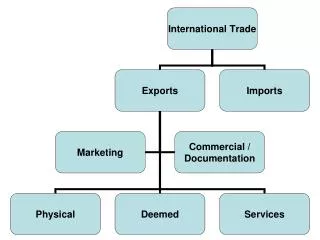
Export • Goods sold in one country but produced in another country
Import • Goods and services bought from sellers in another nation.
Tradebarriers • something that prohibitstrade • Restrictions on trade such as tariffs, quotas and regulations
Tariff • a tax imposed on imported goods.
Quota • anallotment or a production assignment (the amount ) of a good • In international trade, the limit on the quantity of a product that may be imported or exported, established by government lawsorregulations
Regulation • Economic regulation is the prescription of price and output (amount produced) for a specific industry, often a natural monopoly.
Economic Sanction The withholding, usually by several nations, of loans or trade relations with a nation violating international law, to force it to comply.
Embargo • government restriction placed on trade
Exchange rate • the price of one currency in relation to another currency
WAR • War plays an important roll in international trade. Blockades of ports and attacks on merchant ships inhibit trade.
WEATHER • Changes in weather conditions such as hurricanes, tropical storms, blizzards and other conditions can disrupt the distribution of goods and services.
BOYCOTT • Consumers refuse to buy certain products because they are protesting against some issue