The Cold War Heats Up
80 likes | 253 Vues
This chapter explores the tumultuous events of the Cold War era, focusing on the civil war in China as Japan invades during WWII. United against a common enemy, Chinese Communists led by Mao Zedong and Nationalists under Chiang Kai-shek briefly ally, only to descend into civil conflict post-war. Despite U.S. support for the Nationalists, the Communists emerge victorious, leading to the Nationalists' retreat to Taiwan. The chapter also delves into the Korean War, examining the split between North and South Korea and the involvement of the United States and its allies, highlighting the global tensions around Communism.


The Cold War Heats Up
E N D
Presentation Transcript
The Cold War Heats Up Chapter 26 Section 2
I Civil War in China • Japan invades China during WWII interrupting their Civil War • Chinese Communists & Nationalists joined in a common cause against the invader • Communists N under Mao Zedong led struggle • Nationalists S under Chinese pres. Chiang Kai-shek • US sends aid to nationalists • Communists win over ppls support w/ redistribution of lands and collective farms
A. Fighting Breaks out • Coop between nationalists and communists ended as soon as the Japanese left after WWII • Civil war breaks outUS supported Nationalists because they opposed com. • US plays peacemaker while sending monetary aid to nationalists • Communists win the warnationalists fleeing to Taiwan • Island to east of mainland china
B. America Reacts to Communist Takeover • Containment failsconservatives attack Truman • If containment was so important in Euro why not in Asia • State dept. says it tried to support Chiang but if it had done more it would have led to war in Asia that we wernt prepared to fight • Conservatives slam these as excuses and begin to claim that there are communist agents w/in the US gov’t • American fear of communism began to burn out of controlwere exasperated by events in Korea
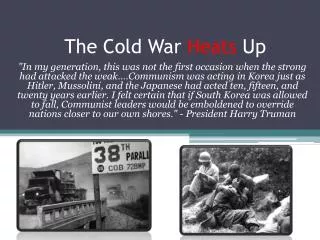
II Koreans go to War • Korea controlled by Japan until end of WWII • Japanese north of 38th parallel surrendered to the Soviets • Japanese south of 38th parallel surrended to Americans • Was not intended to be boundary but it split the country • N= industry & S= agriculture diff. for either regions to prosper • Just like in Germany, 2 nations developed (N=Com & S= Dem/cap) • Republic of Korea= South Korea (capital in Seoul) • Communist form the Democratic People’s Republic of Korea= North Korea (capital in Pyongyang
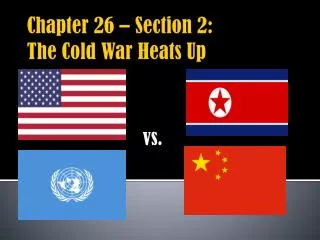
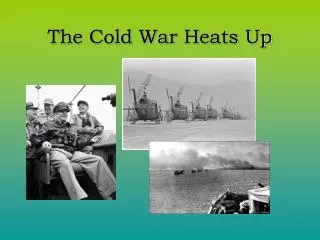
A. North Korea Attacks South Korea • (1950)N Korean troops start Korean War by invading S Korea • Another Asian country was about to fall to com. Truman takes mil. Action • UN security council adopts Amer. Resolution to help Republic of SK • Total of 16 nations send troops to help S Korea under command of MacArthur
III The United States Fights in Korea • ½ N Korean troops surrender and the other ½ flee back to N • UN recommends that MacArthur cross the 38th parallel and unite Korea • Communist China warns that it would not let Americans cross border to unite Korea • UN & S Korean forces go towards borderChinese send troops • China & N Kor. Drive out S Korea and take Seoulfighting for 2 yrs. (stalemate)
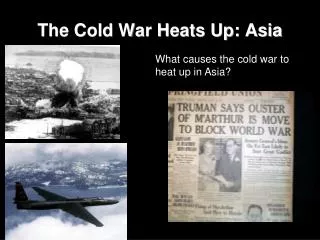
MacArthur wanted to attack China to open up stalemate • Truman does not want massive war in Asia plus, SU had mutual-assistance pact w/ China • Attacking could set off WWIII • UN & S Kor. Take back Seoul and the situation was same as it started • War ends in cease-fire w/ both sides agreeing to 2 things • Cease- fire line on current battle line & establishment of a demilitarized zone between opposing sides • End result = Communists contained but Korea still 2 separate nations • Korean warincreased fear of communism at home