Evaluating Investment Proposals and Break-Even Analysis for Cash Flow Management
60 likes | 196 Vues
This document provides comprehensive solutions for evaluating investment proposals and conducting break-even analysis using net cash flows and salvage values. It covers multiple investment alternatives, required budgetary constraints, and detailed cash flow evaluations. The cash flows for proposals A, B, C, and D, as well as their interdependencies, are analyzed for feasibility under a $500,000 budget. Additionally, the break-even points for an aluminum extrusion plant and a motel investment are calculated considering variable and fixed costs, occupancy rates, and revenue projections.


Evaluating Investment Proposals and Break-Even Analysis for Cash Flow Management
E N D
Presentation Transcript
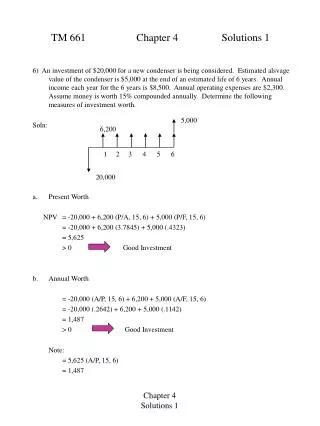
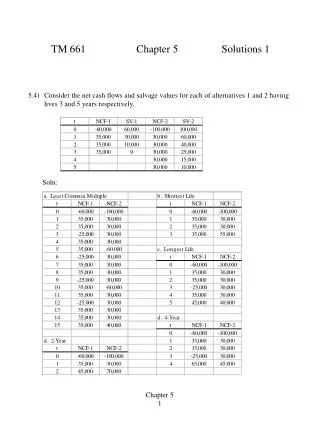
TM 661 Chapter 5 Solutions 1 5.4) Consider the net cash flows and salvage values for each of alternatives 1 and 2 having lives 3 and 5 years respectively. Soln: Chapter 5 1
TM 661 Chapter 5 Solutions 2 5-10) A firm has available 4 proposals A, B, C, D. Proposal is contingent on acceptance of either proposal C or proposal D. In addition, proposal C is contingent on proposal D, while proposal D s contingent on either proposal A or proposal B. The firm has a budget limitation of $500,000. The cash flows are as follows: Initial Costs A = 250,000 B = 350,000 C = 50,000 D = 38,000 Soln: Note we did not need to include the entire cash flow since only the initial costs affect the initial budget of $500,000. Alternative Acceptable Reason A, B, C, D no exceeds budget A, B, C no exceeds budget A, B, D no exceeds budget A, C, D yes A, C no C contingent on D A, B no exceeds budget A, D yes B, C, D yes B, C no C is contingent on D B, D yes C, D no D is contingent on A or B A no A is contingent on C or D B yes C no C is contingent on D D no D is contingent on A or B Chapter 5 2
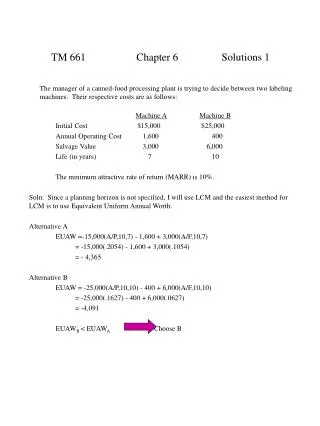
TM 661 Chapter 5 Solutions 3 5-23) Two mutually exclusive proposals, each with a life of 5 years, are under consideration. MARR is 12%. Each proposal has the following cash flow profile. Soln: a. Net Present Worth A NPW = -30,000 + 9,300 (P/A, 12, 5) = -30,000 + 9,300 (3.6048) = $ 3,525 B NPW = -42,000 + 12,625 (3.6048) = $3,511 Choose A b. Incremental Method NPW = -12,000 + 3,325(3.6048) = -14 Choose A Chapter 5 3
TM 661 Chapter 5 Solutions 3 5-23) (Cont) Soln: c. Equivalent Annual Worth A EUAW = -30,000 (A/P, 12, 5) + 9,300 = -30,000 (0.2774) + 9,300 = $ 978 B EUAW = -42,000 (0.2774) + 12,625 = $ 974 Choose A Chapter 5 4
TM 661 Chapter 5 Solutions 5 5-36) An aluminum extrusion plant manufactures a particular product at a variable cost of $0.04 per unit, including material costs. The fixed costs associated with manufacturing the product equal $30,000 per year. Determine the break-even value for annual sales if the selling price per unit is a) $0.40, b) $0.30, and c) $0.20. Soln: Let S = selling price Profit = SX - 30,000 - .04X = (S - .04)X -30,000 Since profit = 0 at breakeven X = 30,000 / (S - .04) a. X = 30,000 / (.4 - .04) = 83,333 b. X = 30,000 / (.3 - .04) = 115,384 c. X = 30,000 / (.2 - .04) = 187,500 Chapter 5 5
TM 661 Chapter 5 Solutions 6 5-37) Owners of a nationwide motel chain are considering locating a new motel in Snyder, Arkansas. The complete cost of building a 150-unit motel is $5 million. The firm estimates that the furnishings will cost $1,875,000 initially and every 5 years thereafter. Annual operating and maintenance cost for the facility is estimated to be $125,000. The average rate for a unit is anticipated to be $55 per day. A 15 year planning horizon is used by the firm in evaluating new ventures of this type. Salvage value is estimated at $1 million. Determine the breakeven if the daily occupancy is estimated to be 10%. Soln: I set up a spreadsheet showing revenues and costs. Revenues were based on an occupancy rate in cell C3. Net present worth is computed at 10%. I then just altered cell C3 until I got a NPV relatively close to 0. I compute an occupancy rate of 37.5%. Chapter 5 6