Download
1 / 11
110 likes | 237 Vues
Successful athlete training requires careful yearly planning tailored to the athlete's maturity and goals. Begin by reviewing past performance and identifying key areas for improvement. Set realistic performance targets and establish an individual development plan alongside a training diary to foster responsibility. Training blocks focus on power development, maximum strength, and specific conditioning, incorporating both technical skills and fitness. Active recovery and testing phases ensure consistent progress, while skill acquisition and pressure testing prepare athletes for competition. Effective planning enhances adaptability and performance.

E N D
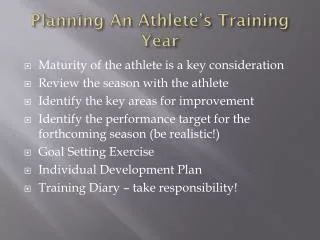
Planning An Athlete’s Training Year • Maturity of the athlete is a key consideration • Review the season with the athlete • Identify the key areas for improvement • Identify the performance target for the forthcoming season (be realistic!) • Goal Setting Exercise • Individual Development Plan • Training Diary – take responsibility!
Development of Power • Hypertrophy (8 weeks) – development of fitness and athleticism/condition to accommodate power/technical proficiency in weightlifting/core strength development through medicine ball/strength through full range of movement at all major joints • Rate of Force Development (6 weeks) – achieve maximum strength levels/develop specific running conditioning levels/develop muscular and ‘sprinting’ conditioning (increase capacity to perform)/develop strength levels in all supplementary exercises • Power (6 weeks) – Increase power through complex training/increase ‘sprinting’ quality/development of rhythm & range
Block 1 - 8 weeks, • Development of fitness & athleticism • Conditioning to Run • Achieve technical proficiency in weightlifting • Achieve core strength through medicine ball work • Achieve strength through full range of motion at all major joints
Block 2 - 6 weeks, • Achieve maximum strength levels • Develop running specific conditioning levels • Develop muscular and running conditioning (increase capacity to perform) • Develop strength levels in all supplementary exercises
Block 3 - 6 weeks, • Increase power through complex training • Increase running quality • Development of running rhythm
Block 4 - 2 weeks • Active recovery • Fitness and running related tests
Block 5 - 4 weeks • Development of Maximum strength • Development of running power • Development of starting speed and acceleration ability
Block 6 - 6 weeks • Development of explosive power • Development of reactive and elastic strength • Continued development of running power
Block 7 - 5 weeks • Maintenance of strength and power • Development of speed and running rhythm • Development of running rhythm with quality • Development of race speed
Adaptation • Active Recovery & Testing • Development of Maximum Strength • Development of Speed/Strength • Tapering and Peaking • Identify/Practice/Complex/Pressurise – Skill Acquisition • Pressure Testing – Performing when it matters!
Finally • You can never plan enough • Develop the athlete and develop the performance • Adaptation to training is a very important factor for improved performance • Training diaries are essential • Athletes have to take responsibility for their performance • Planning is good for the coach and the athlete!