Download
1 / 19
190 likes | 295 Vues
The High Lava Plains Project aims to unravel the causes of continental intraplate tectonomagmatism. Funded by NSF Continental Dynamics, it examines post-12 Ma volcanism in Oregon and Washington, focusing on volcanic activity trends and relationships across the region. Research highlights include migrating volcanic traces, the composition of basaltic materials, and seismic data from an extensive network of stations. Findings suggest a complex interplay between deep mantle processes and surface volcanism, paving the way for better understanding of the geological history of the High Lava Plains.

E N D
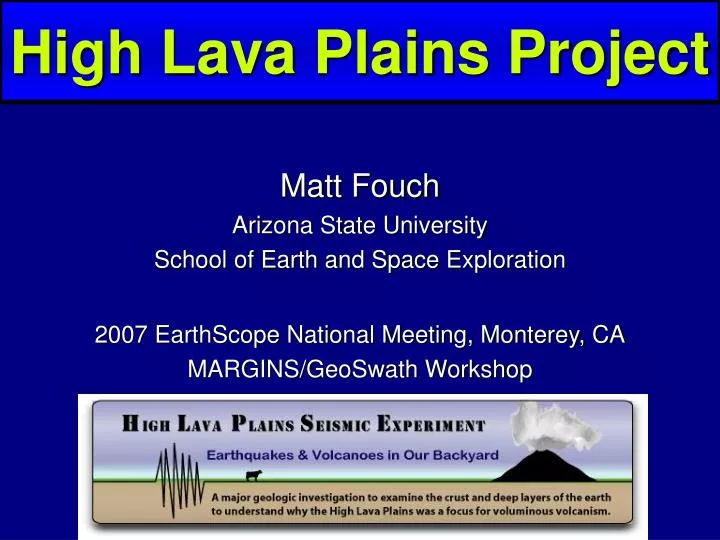
High Lava Plains Project Matt Fouch Arizona State University School of Earth and Space Exploration 2007 EarthScope National Meeting, Monterey, CA MARGINS/GeoSwath Workshop
High Lava Plains Project:Understanding the Causes of Continental Intraplate Tectonomagmatism Arizona State University - Matt Fouch Carnegie Institution of Washington - Rick Carlson, David James Miami University - Bill Hart Massachusetts Institute of Technology - Tim Grove Oregon State University - Anita Grunder, Bob Duncan University of Oklahoma - Randy Keller University of Rhode Island - Chris Kincaid University of Texas, El Paso - Steve Harder Funded by NSF-Continental Dynamics
Observations on Post-12 Ma Volcanism • Two migrating volcanic traces • Migrating volcanism defined by rhyolites • Basaltic activity continuous along both traces • Volcanism in HLP associated with right-lateral S-S faulting as B&R extension dies out to N
Strong Temporal and Spatial Relationships with Basalt Composition • HLP basalts become more primitive with time • Composition shifts towards a high-Al tholeiite consistent with a very shallow mantle source • Primitive basalts across HLP show limited isotopic variation • Changes dramatically at border with Precambrian North America
Isostatic Gravity • Eastern OR/WA show no gravity signal of underplated basalt, unlike SRP • Where are the fractionation products of 250,000 km3 of flood basalts and underplating expected with HLP volcanism?
LOGISTICS:Local Contacts Essential • 2-pager (Jenda Johnson) • Town meetings / school visits • “Kicking dirt”
Timeline: Seismic Component October 2005 Reconnaissance January 2006 Install Phase Ia (4 instruments) June 2006 Install Phase Ib (12 instruments) October 2006 Recon (19 sites; vaults constructed) April 2007 Recon (~60 sites) June 2007 Complete Phase I (102 stations) September 2008 Phase II (relocate ~70) Active source experiment Fall 2009 Demobilization Summers: “Friends of HLP” meetings
Shear Wave Splitting Across the PNW • Very simple across most of region • Local complexity near Cascades and accreted terranes N=439
Opportunities from Dense Seismic Coverage Across the Pacific Northwest • Over 250 BB sites in addition to ~75 USArray and permanent stations
Opportunities from Dense Seismic Coverage Across the Western U.S. • Over 400 BB sites in addition to USArray and permanent stations
Observations on Neogene Volcanism • B&R and volcanism does not notice pC continental boundary • Volcanism concentrated at B&R margins, particularly Northern boundary • Volcanism does not obviously correlate with extension amount • Largest volume of basalt erupted well N of SRP; no associated silicic volcanism • Bimodal volcanism characteristic of HLP, SRP and B&R • ~4 Myr hiatus between flood basalts and beginning of rhyolite migrations
Shear Wave Splitting Across the PNW • Very simple across most of region • Larger splitting times in southern Cascadia N=439